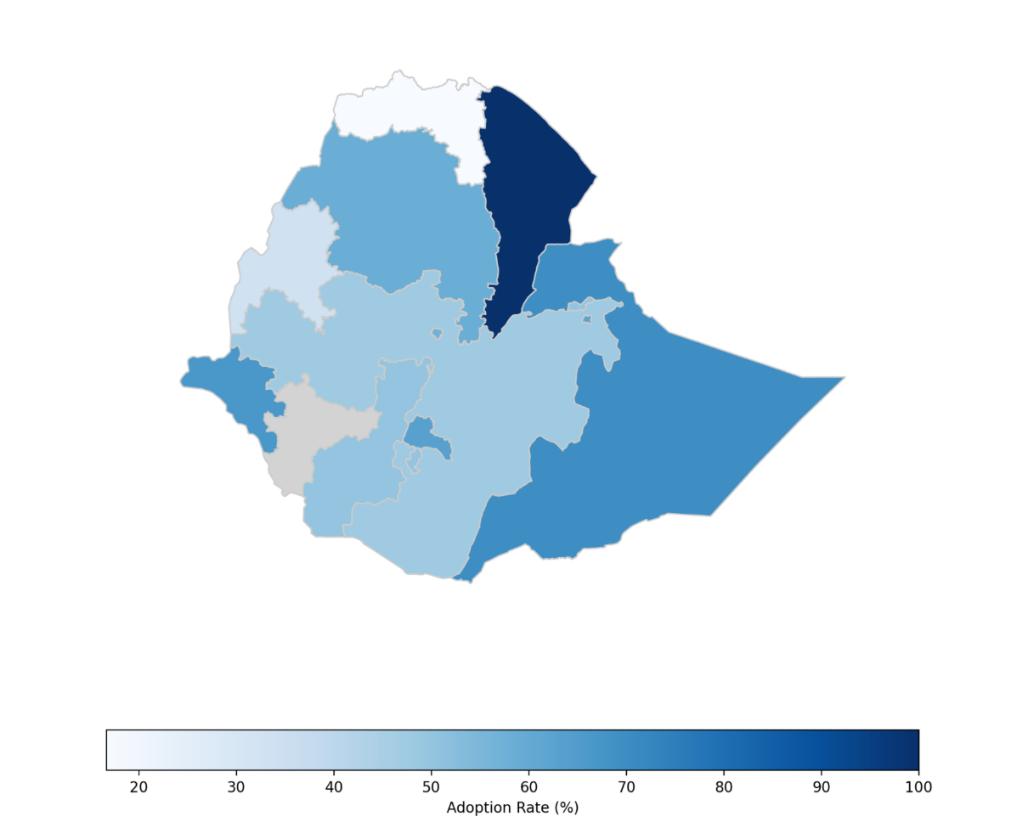
 Regional adoption rates across Ethiopia's federal regions. Explore the interactive dashboard for the full picture.
Artificial intelligence is reshaping healthcare worldwide. For Ethiopia, a nation of more than 120 million people carrying a dual burden of infectious and chronic disease, AI promises a way to stretch scarce resources and widen access to care. How that promise translates into clinical reality has, until now, been largely unmapped.
This landscape analysis surveyed 449 healthcare professionals (doctors, nurses and midwives, public health officers, pharmacists and IT specialists) across 13 regions and city administrations, to see how ready the workforce is for that transition.
Three findings
- The knowledge-practice paradox. More than 75% of respondents correctly identified basic AI definitions, yet knowledge barely predicts use (r = 0.14). Education is no longer the main bottleneck; infrastructure is.
- The anxiety curve. A third of the workforce (33%) fears being replaced by AI. That anxiety is often higher among specialist physicians and PhD holders than among junior staff.
- Innovation beyond the capital. Adoption is not confined to Addis Ababa. Sidama shows surprisingly intense adoption, which points to the potential for regional centres of excellence.
How the study was done
The survey followed the Knowledge, Attitude and Practice (KAP) model:
- Knowledge: understanding of AI definitions, ethics and limitations.
- Attitude: optimism about AI against fear of displacement.
- Practice: how often AI tools are used, which ones, and whether their outputs are checked.
Respondents were reached through professional networks (LinkedIn, Telegram and medical associations), so this is a convenience sample: 449 validated responses after cleaning, from Addis Ababa, Oromia, Amhara, Sidama, Somali, Tigray, Southern and Central Ethiopia, Harari, Dire Dawa, Afar, Benishangul Gumuz and Gambella. The analysis used Python (Pandas, Plotly, GeoPandas) for correlation, geospatial clustering and sentiment analysis.
Knowing about AI: the literacy illusion
Ethiopia's health workforce is past the stage of simply not knowing what AI is. But much of that knowledge is shallow:
- The ethics gap. Some respondents who were confident about AI definitions were unsure about its ethical implications. This is "buzzword literacy": knowing the term machine learning without grasping its statistical dependencies or its potential for bias.
- Diagnosis before treatment. Confidence is much higher in AI for diagnosis (radiology, pathology) than for treatment planning, which mirrors where AI tools are most mature globally.
Feeling about AI: hope and fear at once
Attitudes swing between strong optimism and real worry:
- Efficiency against displacement. Most agree AI will reduce administrative burden, yet about 33% fear it will eventually replace physicians.
- The expert paradox. Specialists are the most anxious, perhaps because diagnostic expertise is exactly what AI aims to replicate.
- A call for regulation. About 86% want strict government regulation. In Ethiopia, regulation is seen not as a brake but as a precondition for trust.
Using AI: the practice gap
- Polarised use. The heaviest users tend to be younger, urban men; non-users are concentrated where infrastructure is weakest.
- Shadow IT. High use in places with little official digital infrastructure suggests health workers are turning to personal phones and consumer tools such as ChatGPT for clinical questions. It is resourceful, but it carries real risks for patient privacy and safety.
- Automation bias. Some of the heaviest users said they rarely or never verify AI outputs. Blind trust in an algorithm is a latent clinical risk, especially for drug doses and interactions.
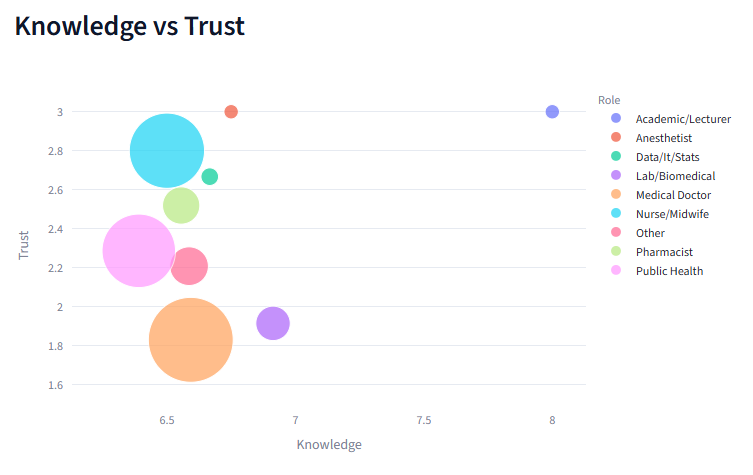 Knowledge against trust, by role. Bubble size reflects the number of respondents.
Where AI is taking hold
The data challenges the idea that digital health in Ethiopia begins and ends in the capital. Sidama, perhaps helped by regional health initiatives and Hawassa University, stands out. In Afar and Somali, respondents show strong enthusiasm, a kind of "digital hunger", but low practice: AI is seen as a way to fill specialist gaps, and infrastructure is what holds it back.
What should change
More teaching about what AI is now brings diminishing returns. Four shifts would do more:
- Infrastructure first. Move investment from awareness workshops to subsidised data and verified hardware. Access is the strongest predictor of practice.
- Teach AI hygiene. Train clinicians to question and verify AI outputs, not just to use the tools.
- Back regional innovation. Recognise and fund emerging hotspots like Sidama, so tools are tested in diverse settings rather than only in Addis Ababa.
- Keep humans in the loop. The Ministry of Health should state clearly, in policy, that AI augments clinicians rather than replaces them.
Read the full report
- Full report (PDF), with DOI: doi.org/10.5281/zenodo.17792784
- Interactive dashboard
- Code on GitHub (MIT licence)
Participant data has been anonymised and aggregated; the raw dataset is not public. The report is published under a CC BY 4.0 licence.
Cite as: Mekonnen, A. M. (2025). The State of AI in Ethiopian Healthcare: A 2025 Landscape Analysis. Zenodo. https://doi.org/10.5281/zenodo.17792784