
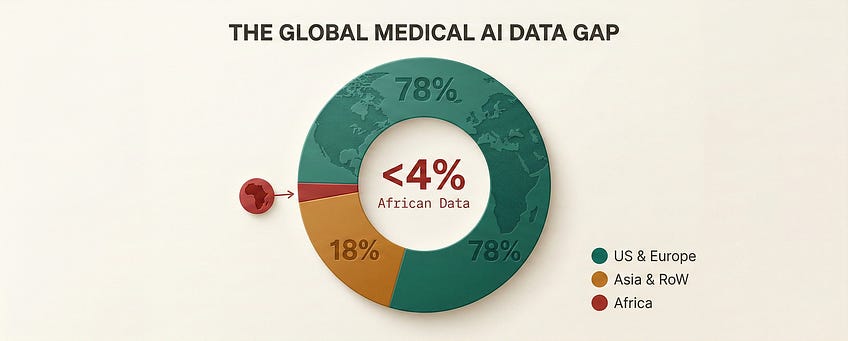
African clinicians are already using AI tools built in the US and Europe. Most of them use those tools carefully, as guides, not arbiters. And many of them know exactly why.
Every month, a new AI tool lands in an African hospital with a press release and a pilot program. Chest X-ray interpretation. Malaria detection. Neonatal risk scoring. Some of these tools are genuinely impressive. A few of them are changing how care is delivered in facilities that have one doctor for every 36,000 people in some rural counties.
But here is what those press releases rarely say: the model was trained on data that did not come from those patients.
That gap, between where the training data came from and where the tool is deployed, is the defining challenge of AI in African healthcare right now. It is not a technology problem. It is a data sovereignty problem. And solving it requires a different conversation than the one we are currently having.
What African Clinicians Already Know
In a 2025 study published through the ACM Conference on Fairness, Accountability, and Transparency, researchers interviewed physicians and nurses across multiple African countries about how they use AI diagnostic tools. One physician from Mauritius put it plainly: “All the software and medical devices we use have been developed in the USA or Europe. The outputs are indicative only and assist in formulating a preliminary diagnosis.”
That is not skepticism about AI. That is clinical judgment. Experienced practitioners know that a model trained on, say, imaging data from European hospitals will carry assumptions, about baseline anatomy, disease prevalence, comorbidity patterns, even equipment quality, that do not transfer cleanly to a district hospital in rural Ethiopia or southern Nigeria.
The problem compounds when you consider what the training datasets actually look like.
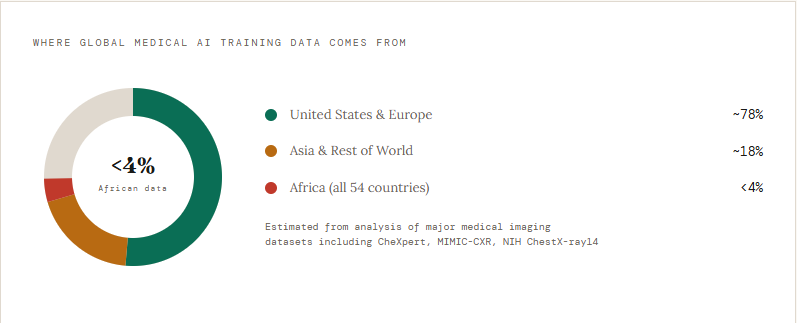
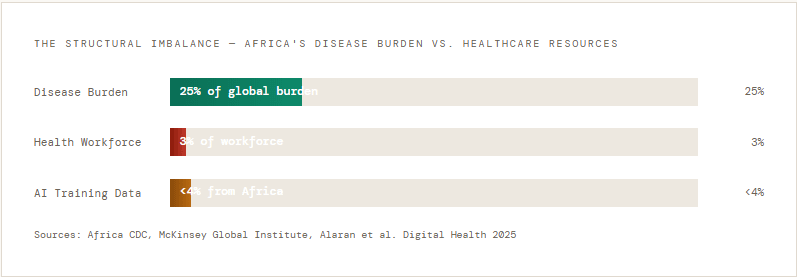
Less than 4% of the training data powering global medical AI comes from Africa, a continent that carries 25% of the world’s disease burden. This is not an oversight. It is the product of decades of underinvestment in African health data infrastructure, ethics review capacity, and the legal frameworks needed to share clinical data across borders safely.
The result: AI tools arrive in African health systems pre-loaded with someone else’s assumptions. The model may never have seen a case of sickle cell disease at the frequency it appears in West Africa. It may underperform on TB detection in patients with HIV coinfection at rates common in southern Africa. It may not account for the nutritional deficiency patterns that shape pediatric presentations across the Sahel.
These are not edge cases. They are the everyday clinical reality.
The core issue is not whether AI works in African healthcare. It does, in specific, well-designed applications. The issue is who controls the data that defines what “works” means, and for whom.
Three Things Africa Needs to Build, Not Buy
Acknowledging the data sovereignty problem is the easy part. The harder question is what it actually takes to fix it. In my view, three things need to happen in parallel.
First, African health systems need federated clinical data infrastructure. This means investing in the technical and legal architecture that allows clinical data to be used for model training without leaving national jurisdictions. Ethiopia’s Health Information Exchange, Ghana’s National Health Data Repository, and similar initiatives are early steps. They need policy teeth and long-term funding, neither of which should depend on a donor grant cycle.
Second, AI governance frameworks need to be built from African clinical realities, not retrofitted from elsewhere. The WHO’s AI for Health ethics guidance is a useful starting point. But African ministries of health need to localize these frameworks with specificity: who reviews AI tools before deployment? What validation evidence is required in African patient populations? Who bears liability when an AI recommendation leads to harm?
Third, we need African-led AI model development, not only African deployment of external models. Rwanda’s Mbaza NLP project, Lelapa AI in South Africa, and Masakhane’s work on African language models show what becomes possible when African researchers lead. These efforts need structured support from ministries, from Africa CDC, and from international partners willing to be co-investors rather than solution exporters.
Optimistic, But Clear-Eyed
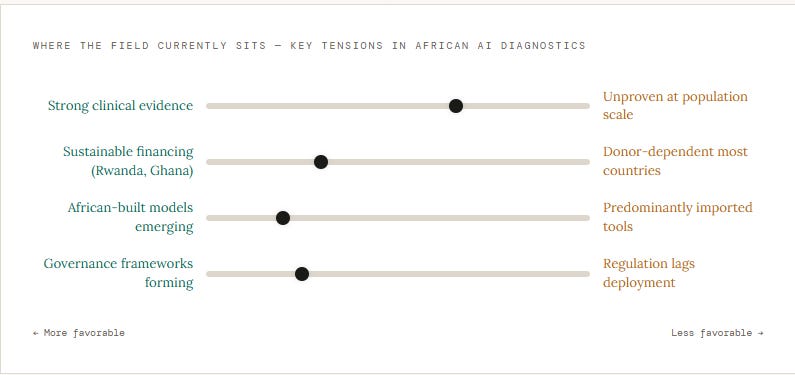
I am not pessimistic about AI in African healthcare. A community health worker in Siaya County diagnosing malaria in 90 minutes with a $50 microscope and a smartphone is a real story. An LLM quietly flagging drug interaction errors in a Nairobi clinic is a real story. These tools are extending clinical capacity in ways that training alone cannot match fast enough.
But optimism without clarity does a disservice to the patients these tools are supposed to serve. A diagnostic AI that performs brilliantly on American imaging data and mediocrely on Ethiopian patient presentations is not a neutral tool. It encodes a hierarchy of whose health data matters enough to train on.
Africa does not need to wait for better AI. It needs to build the conditions under which AI works for African patients on African terms. That means data infrastructure, governance frameworks, and African-led model development. And it means the international community treating African health data not as an extraction opportunity, but as something African systems should own, protect, and benefit from.
The technology is ready. The question is whether the systems around it are.
“What would it take for your country to own its clinical AI ecosystem, not just use someone else’s?”
I’m interested in what you’re seeing on the ground. If you work in digital health, health policy, or AI governance in Africa, I’d like to hear your perspective.