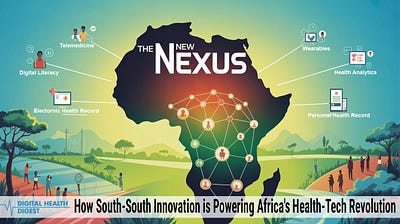
Across our continent, digital health innovation is everywhere.
Most Ministries of Health can list more than ten digital health projects running at the same time, each with its own app, dashboard, server and donor report.
Yet when leadership asks a simple operational question, “How many facilities submitted data last month?”, the answer still requires phone calls, spreadsheets, and manual reconciliation.
This contradiction reveals a hard truth:
Africa does not have a shortage of digital health solutions. It has a shortage of national digital health systems.
The pilot paradox
Behind impressive slide decks and demo dashboards, too many digital health tools never move beyond:
- a pilot district
- a donor funding cycle
- a single champion within the ministry
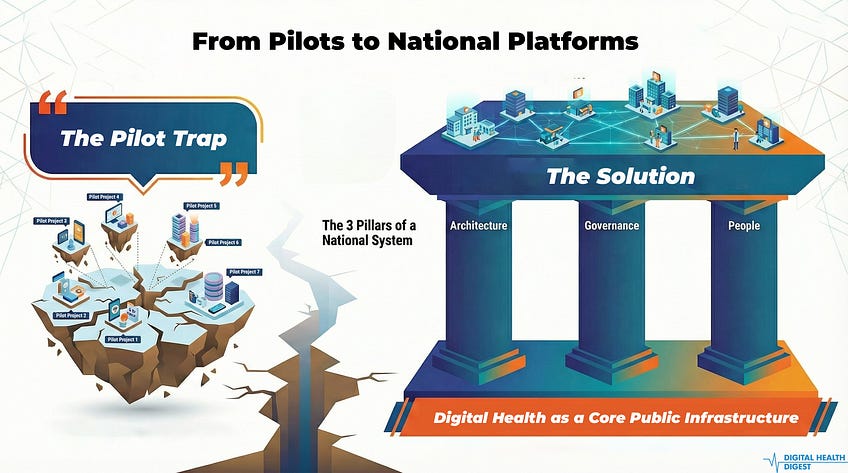
This is often described as the “pilot graveyard.”
But pilots do not fail because of weak ideas or poor technology. They fail because no system was ever designed to absorb them.
Innovation without systems produces fragmentation, not scale.
Fragmentation by design, not by accident
When each implementing partner brings its own:
- platform
- data model
- login credentials
- reporting workflow
the ministry inherits a patchwork, not a health information system.
Frontline workers are forced to juggle multiple applications that do not talk to each other. Data becomes siloed inside vertical programs. Digital tools increase workload instead of reducing it.
Procurement decisions often prioritize individual solutions rather than:
- national architecture
- interoperability standards
- long-term ownership
Even well-designed tools struggle to scale because they were never aligned to a shared national blueprint.
The shift that matters: from projects to platforms
Through work shared via Digital Health Digest and advisory roles across African health systems, one pattern is consistent:
Countries that scale digital health successfully stop thinking in terms of projects and start building platforms.
This shift rests on three foundational pillars.
Pillar 1: National architecture and standards
Every country needs a clear, government-owned digital health architecture that defines:
- core registries and shared services
- interoperability standards
- data exchange mechanisms
Without architecture, each new tool adds complexity instead of capability.
Architecture is not technical bureaucracy. It is sovereignty over the health system’s digital future.
Pillar 2: Workforce and change management
Digital health does not fail because health workers resist technology.
It fails because systems are deployed without:
- training
- clear roles
- accountability
- incentives aligned to data quality
Scaling requires internal digital health capacity within government—not permanent reliance on vendors.
Ownership must sit inside institutions, not contracts.
Pillar 3: Governance and sustainable financing
Pilots are funded as short-term projects. National systems must be funded as long-term infrastructure.
This means:
- multi-year budgeting
- clear data ownership and stewardship
- procurement rules that reward interoperability and reuse
If a system collapses when funding ends, it was never national to begin with.
Practical steps governments can take now
Ministries do not need to start from scratch. They can repurpose existing investments by adopting a systems lens:
- Map and rationalize the current digital health ecosystem
- Enforce interoperability as a procurement requirement
- Treat EMRs and data exchange as core infrastructure
- Build internal capability, not long-term dependency
None of these require new technology. They require leadership, coordination, and discipline.
Final reflection: pilots don’t fail and systems are never built
The difference between a digital health pilot and a national system is not innovation.
It is:
- architecture
- governance
- people
Our governments that treat digital health as core public infrastructure, planned, funded, and governed at the highest level, will be the ones that achieve real impact at scale.
An invitation
If you lead or advise a:
- Ministry of Health
- regulatory authority
- regional health body
and are ready to move from pilots to platforms, this is the work explored through Digital Health Digest and advisory engagements.
For:
- keynote talks
- closed-door strategy sessions
- national digital health architecture workshops
feel free to connect via LinkedIn or through Digital Health Digest.
Let’s stop scaling pilots. Let’s start building systems.