A Declaration of Self-Reliance
The global COVID-19 pandemic was a watershed moment, a crisis that laid bare the deep-seated inequities of the international order. For Africa, the experience of "vaccine apartheid", a period of gross nationalism and artificially restricted supplies that left the continent dependent on a handful of powerful nations, was a painful but clarifying lesson. It exposed the fragility of a development model reliant on North-South technology transfer and philanthropy.
Yet, out of this crucible of dependency, a powerful new narrative is being forged: one of defiance, self-reliance, and continental collaboration. The story of African health-tech is no longer about importing solutions; it is about building them, sharing them, and funding them from within.
No single event captures this continental pivot more profoundly than the genesis of the World Health Organization (WHO) mRNA Technology Transfer Hub in South Africa. Initially positioned as a flagship initiative to receive and disseminate vaccine manufacturing technology from the Global North, its journey took a decisive turn.
Despite early indications that companies like Moderna would share their technology, the promised transfer never materialized, leaving the hub at a critical crossroads. Faced with this roadblock, the hub did not falter. Instead, it pivoted. The mission transformed from one of passive reception to one of active creation.
This homegrown effort, driven by a desire for long-term sustainability, successfully developed its own mRNA vaccine candidate, demonstrating a remarkable capacity for indigenous innovation. The hub became a symbol not of what Africa could be given, but of what it could build for itself. Its network of "Spokes", local manufacturers across the Global South, is now designed as a virtuous circle of reciprocal innovation, with partners contractually committed to sharing back improvements and addressing health needs relevant to their own populations.
This story is a microcosm of a much broader movement. Across the continent, a new, self-sustaining ecosystem is emerging, powered by a virtuous cycle of specialized innovation hubs, the cross-pollination of homegrown solutions, and the rise of a new class of context-aware African investors.
The concept of South-South cooperation, a framework for collaboration among developing countries, has moved from a policy ideal to a market reality, driven by shared experiences and a collective ambition for technological sovereignty. The narrative of African healthcare is no longer one of passive reception. This report will map this new landscape, providing evidence that South-South innovation is the most powerful force shaping the future of health on the continent.
The Constellation of Innovation: Mapping Africa's Health-Tech Hubs
The narrative of African tech innovation has long been dominated by the "big three", Nigeria, Kenya, and South Africa. While these nations remain pivotal, a more nuanced and powerful reality is taking shape. A constellation of specialized hubs is emerging across the continent, each cultivating unique, complementary strengths. This diversification signals a maturing ecosystem where different national strategies contribute to a collective continental capacity.
From the policy-driven testbeds of Rwanda to the fintech-fueled platforms of Ghana and the AI-powered diagnostic frontier in Egypt, Africa is building a multi-faceted innovation engine to solve its own healthcare challenges.
Rwanda: The Governance Blueprint
Rwanda has strategically engineered its entire nation into a "sandbox" for digital health, where a deliberate, top-down policy approach creates a stable and predictable environment for large-scale innovation. This is not innovation by accident, but by design. The foundation of this model is a clear, long-term government vision, articulated in comprehensive frameworks like the fifth Health Sector Strategic Plan (HSSP V).
Launched in early 2025, HSSP V is not a standalone document; it is explicitly aligned with Rwanda's Vision 2050 and the UN's Sustainable Development Goals, and it directly prioritizes "Research, Innovation, Biomanufacturing, Regulation, and Digitalization". This demonstrates a deeply integrated, whole-of-government approach to fostering a knowledge-based economy.
"Rwanda's 'policy-first' model continues to create an enabling legal environment that attracts significant investment, although the digital health sector has faced a recent challenge. Previously, a prime example of this model's success was the 10-year public-private partnership with the digital health provider Babyl, facilitated by the country's PPP law. This partnership had successfully scaled telemedicine services nationwide, integrating with the national community-based health insurance scheme managed by the Rwanda Social Security Board (RSSB) and leveraging the National ID Agency (NIDA) to simplify user registration, which dramatically increased adoption, particularly among women.
Following Babyl's cessation of operations in late 2023 due to the bankruptcy of its parent company, Rwanda is actively navigating the impact on its national digital health strategy. While the departure of a major service provider has created a gap, the underlying strengths of the government's proactive and policy-driven approach to partnerships remain. The established integrations with RSSB and NIDA serve as a valuable foundation for future digital health initiatives. The continued attraction of foreign direct investment across other sectors demonstrates the ongoing success of Rwanda's commitment to fostering a secure and predictable investment climate."
The launch of the Health Intelligence Center (HIC) in April 2025 represents the culmination of this data-driven governance strategy. The HIC is a national platform that consolidates real-time data from every level of the health system, from community health workers to national referral hospitals, and leverages AI to drive evidence-based policy, disease surveillance, and resource allocation.
This infrastructure turns the entire country into a sophisticated feedback loop, allowing for smart, responsive policymaking. Foundational initiatives like "One Patient, One Record," enabled by the Rwanda Health Information Exchange (RHIE), further underscore this commitment to building robust, interoperable digital infrastructure from the ground up, solving systemic challenges that plague health systems elsewhere.
Rwanda's success offers a powerful proof-of-concept for the rest of Africa, even if its specific model is not universally replicable. The country's unique political will and centralized governance structure allow for rapid, nationwide implementation of complex digital health solutions, something far more challenging in larger, federated states. Rather than waiting for organic, bottom-up innovation to emerge, the Rwandan government actively creates the demand and the regulatory framework, essentially inviting technology companies to solve pre-defined national priorities.
This makes the country an ideal, low-risk testbed. A company can pilot a solution at a national scale, generating robust data and a proven case study that can then be used to attract investment and expand into other African markets. While other nations may not be able to copy the "Rwanda Model" exactly, its success demonstrates the transformative potential of aligning digital health strategy with national policy, inspiring similar ambitions and providing a blueprint for governance-led innovation across the continent.
Ghana: Where FinTech and HealthTech Converge
Ghana's burgeoning health-tech ecosystem is built upon the solid and ubiquitous rails of a mature mobile money infrastructure. The country's experience demonstrates a powerful developmental sequence: solving financial inclusion first can dramatically accelerate the adoption of digital health and other essential services.
Ghana has emerged as one of Africa's leaders in mobile money, with penetration projected to exceed 60% by 2026 and transaction values surging to an estimated GH¢335 billion (approximately $33 billion) in 2024 alone. This widespread adoption, driven by services like MTN MoMo and Telecel Cash, has created a trusted, accessible, and interoperable digital payment system that reaches deep into rural areas.
The Ghanaian government has strategically leveraged this powerful infrastructure as a platform for public service delivery. A standout example is the National Health Insurance Scheme (NHIS), which now collects over 60% of its premiums via mobile money. This simple integration has solved a massive collections and accessibility challenge, making it easier for citizens to enroll and stay covered.
Similarly, the Ghana government platform aggregates a wide array of government services, including health, with seamless digital payment integration built-in, promoting transparency and efficiency. This approach is underpinned by a forward-thinking national strategy, the "Ghana Digital Payments Roadmap," which explicitly identifies improved efficiency in "health delivery" as a key objective of its push towards a cash-lite economy.
Looking ahead, the government's commitment is deepening. The announcement of a new US$50 million Fintech Growth Fund is designed to catalyse this ecosystem further by supporting homegrown innovators. Crucially, the policy explicitly recognizes the symbiotic relationship between fintech, health-tech, and data-tech as a unified engine for economic growth, signalling a sophisticated understanding of how these sectors reinforce one another.
The Ghanaian model reveals a critical insight for digital development across the continent. In many markets, a health-tech start-up faces the dual challenge of solving a health problem and a payment problem simultaneously. This doubles the friction for user adoption and adds significant operational complexity. In Ghana, the payment problem has been largely solved. The existence of a pervasive and trusted mobile money system means that health-tech innovators can effectively "plug into" an existing financial rail.
This dramatically lowers the barrier to entry, reduces the cost of customer acquisition, and allows startups to focus on their core competency: delivering quality health services. They can innovate with the confidence that the payment mechanism is already in the user's hand and trusted. Ghana's experience suggests that establishing robust digital financial infrastructure is a powerful, and perhaps even necessary, precursor to the successful digitization of other essential services like healthcare, offering a strategic lesson for other nations charting their digital transformation journeys.
Egypt: The AI and Diagnostics Frontier
Egypt is pursuing an ambitious national strategy to leapfrog legacy healthcare systems, positioning itself as the continent's AI and diagnostics frontier. The country's approach is not merely to procure foreign technology but to build a sovereign AI capability through strategic international partnerships and the creation of massive, high-quality national data repositories. The Egypt Healthcare Authority (EHA) is at the vanguard of this transformation, with the explicit strategic goal of adopting artificial intelligence to improve diagnostic precision and leverage big data for innovative and efficient care.
A cornerstone of this strategy is the imminent pilot launch of a national AI-powered remote diagnostics platform. This platform, which will rely on WHO-approved treatment protocols, is designed to be a breakthrough in the country's digital health transformation, enhancing both diagnostic accuracy and emergency response times. This initiative is part of a broader push to integrate AI across the healthcare value chain, from analyzing medical images with greater speed and precision to predicting complications and reducing healthcare costs.
Crucially, Egypt's strategy is focused on building local capacity and intellectual property, not just consuming foreign products. This is evident in its carefully selected partnerships. The EHA is collaborating with global leaders like PaxeraHealth to develop "locally authored imaging AI algorithms," ensuring that the solutions are tailored to the national context. It is also working with firms like Konecta and Roche to establish local "centres of excellence" dedicated to AI and health data analytics, fostering a domestic talent pool.
This entire endeavor is fueled by the creation of a formidable national asset: a repository of over half a billion medical images, providing the vast quantities of high-quality data needed to train, validate, and refine these AI models. This is complemented by the development of advanced Electronic Health Record (EHR) systems using state-of-the-art language models like Llama3-OpenBioLLM-70B to generate actionable clinical summaries and reports.
Egypt's approach to AI in healthcare is more than a technological upgrade; it is a sophisticated geopolitical and economic strategy. Control over healthcare AI is fundamentally a matter of data sovereignty. An AI model trained on Egyptian data to address Egyptian population health needs will inevitably be more effective, less biased, and better aligned with national priorities than a generic global model. By partnering to co-develop and author local algorithms, Egypt is building its own intellectual property and human capital, avoiding the trap of becoming a passive consumer of foreign technology.
The creation of a massive, centralized medical data repository is a powerful strategic moat; in the world of AI, high-quality data is the most valuable fuel, and owning such a dataset gives Egypt a significant and durable competitive advantage. This positions the country not just to revolutionize its own healthcare system, but to emerge as a regional hub for AI-driven health services. Egypt is building an asset it can potentially export, sharing its expertise and technology with other nations in Africa and the Middle East, thereby turning a domestic health initiative into a significant economic and geopolitical force.
The Cross-Pollination Effect: How African Solutions Travel
One of the most compelling signs of a maturing, self-sustaining ecosystem is the cross-pollination of ideas and business models across national borders. The narrative is no longer defined by solutions flowing from North to South, but by African-founded, African-funded companies successfully scaling their operations from one African country to another. This intra-continental expansion is evidence of a new reality where innovators are developing resilient, context-aware models that are proving adaptable and scalable across the continent's diverse markets.
Companies like Helium Health and mPharma are not just building products; they are building pan-African platforms, demonstrating that the most effective solutions for Africa's challenges are increasingly being found within Africa itself.
Case Study: Helium Health - Building the Digital Backbone of African Healthcare
Helium Health's impressive pan-African growth demonstrates a sophisticated "full-stack" expansion model, where a core software product is ingeniously bundled with a fintech solution to create a powerful, self-reinforcing flywheel for growth.
Founded in Nigeria, the company has successfully expanded its footprint to at least seven countries, establishing a significant presence in markets including Ghana, Kenya, Liberia, Senegal, and Uganda. This expansion is not based on a one-size-fits-all product, but on a suite of integrated solutions meticulously tailored for the African context.
At its core is HeliumOS, a comprehensive Electronic Medical Record (EMR) and hospital management system that enables clinics and hospitals to digitize their entire workflow, from patient records to billing and prescriptions. However, the true genius of Helium's model lies in its synergy with
HeliumCredit, a digital financing product. The rich operational and financial data generated by facilities using HeliumOS is leveraged to assess their creditworthiness. This allows Helium Health to disburse much-needed loans to these healthcare providers in as little as 48 hours, a process that is transformative in a market where access to capital is a primary constraint.
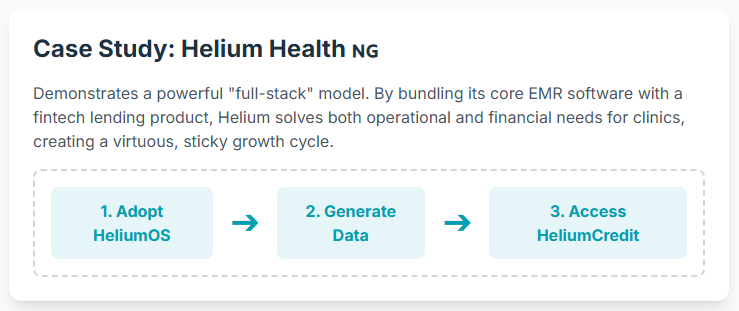
This creates a virtuous and remarkably "sticky" cycle. A clinic adopts HeliumOS to improve its operational efficiency and digitize records. The data generated through the platform then unlocks access to credit via HeliumCredit. The clinic uses this financing to upgrade its equipment, expand its services, or purchase medications in bulk, which in turn improves its revenue and operational capacity, further embedding it within the Helium ecosystem.
The company's successful $30 million Series B funding round was explicitly raised to expand the HeliumCredit product into new markets like Kenya, a clear validation from investors of this fintech-led growth strategy. Furthermore, its acquisition of Meddy, a doctor-booking platform in Qatar now known as HeliumDoc, signals an even broader ambition that extends beyond Sub-Saharan Africa.
The success of this model reveals a deep understanding of the African healthcare market. A standalone EMR system, while useful, has a limited value proposition in a low-resource setting where a clinic owner's most pressing problem is often not digital records but immediate cash flow and access to capital for growth. Helium Health recognized this critical distinction. They did not just sell software; they sold a holistic solution to a fundamental business problem. The EMR serves as the key that unlocks the door to a more urgent and valuable prize: financing.
This integrated EMR-fintech flywheel makes the platform far more indispensable than a simple Software-as-a-Service (SaaS) subscription. A clinic is highly unlikely to switch EMR providers if doing so means severing its primary line of credit. This demonstrates a mature, context-aware business strategy that moves beyond importing standard Silicon Valley playbooks.
To scale successfully across Africa, companies must build integrated solutions that solve the entire ecosystem of problems their customers face, clinical, operational, and, most critically, financial.
Case Study: mPharma - Reimagining the Pharmacy Across Borders
The rapid and resilient expansion of mPharma, including its notable success in challenging Francophone markets, is driven by a highly replicable, operationally-focused business model. This model solves a universal and critical pain point for independent pharmacies, allowing mPharma to build a vast physical network upon which higher-value digital services can be layered.
Founded in Ghana in 2013, mPharma now operates in a host of countries, including Nigeria, Kenya, Zambia, and Ethiopia, and has executed a strategic and remarkably successful push into Francophone Africa, establishing a strong presence in Benin, Togo, and Côte d'Ivoire.
The company's core offering is Vendor-Managed Inventory (VMI). In this model, mPharma effectively takes over the procurement and inventory management for its partner pharmacies. By aggregating demand across its large network, it can negotiate significantly lower drug prices directly from manufacturers and ensure a consistent and reliable supply of quality-assured medicines.
This directly addresses the two most critical business challenges for small, independent pharmacies: frequent, costly stockouts and the inability to compete on price. This value proposition is so compelling and universal that it has proven highly adaptable, allowing mPharma to achieve a $1.5 million annualized revenue run rate in Francophone Africa within just seven months of market entry.
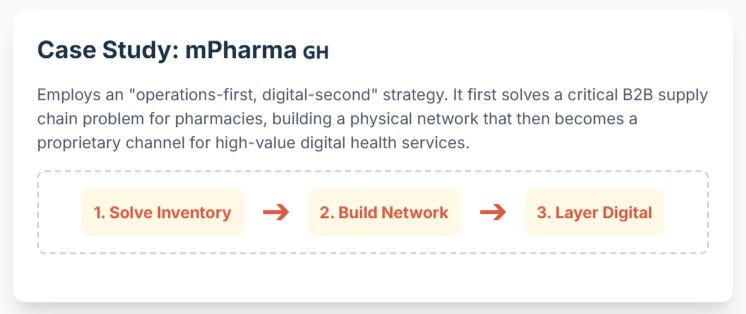
With this robust physical and operational network established, mPharma is now strategically layering digital health services on top. It is transforming its "Mutti" branded pharmacies into comprehensive primary care hubs. By equipping them with telehealth capabilities, mPharma is creating "virtual doctor offices" within the trusted and accessible community pharmacy setting, allowing patients to receive remote consultations and medical advice. The company's ambition is to expand this network tenfold, creating a truly integrated healthcare delivery system that combines physical access with digital convenience.
mPharma's strategy effectively inverts the typical tech startup model. Instead of leading with a purely digital app and then struggling to gain traction and build trust, mPharma builds the tangible, operational network first. It enters a new market by solving a B2B problem for pharmacies, which builds immediate trust, generates revenue, and establishes a physical footprint. This VMI model is relatively asset-light compared to building a pharmacy chain from scratch, enabling faster and more scalable expansion.
Once this network of partner pharmacies is in place, it becomes a powerful and proprietary distribution channel for a wide range of other services, most notably telehealth. The trust, the brand, and the physical presence are already established. This "hybrid" or "operations-first, digital-second" approach is proving to be exceptionally resilient and effective for scaling across Africa's diverse and fragmented markets, offering a powerful blueprint for building sustainable health-tech ventures on the continent.
The Smart Capital: The Rise of Context-Aware African VCs
The fuel for this South-South innovation engine is increasingly being supplied by a new generation of African-led and Africa-focused venture capital (VC) funds. The emergence of this "smart capital" is a critical and defining feature of the ecosystem's newfound maturity. These investors provide far more than just financial backing; they bring patient, context-aware capital, deep local networks, and a nuanced understanding of the continent's unique challenges and opportunities.
This shift from reliance on foreign capital, which often lacks the granular knowledge required to navigate complex local markets, to a robust domestic investment community is fundamentally changing the calculus for health-tech entrepreneurs, enabling the growth of more resilient and sustainable businesses.
Beyond the Cheque: The Value of Contextual Knowledge
Foreign capital, while significant, often struggles with the intricacies of Africa's diverse regulatory landscapes, fragmented supply chains, and varied consumer behaviors. African VCs, by contrast, possess deep contextual knowledge that allows them to de-risk investments and provide far more effective strategic guidance. They understand that successful solutions for the continent cannot be mere imports of Western models; they must be built for Africa, by people who understand its realities.
This local expertise is invaluable in forging critical partnerships with governments, local distributors, and other key stakeholders, connections that can make or break a startup. Furthermore, these funds are often structured with a deeper appreciation for the longer, more complex routes to commercialization that are common in sectors like deep tech, offering more patient capital than traditional VCs might. This combination of capital and context is creating a fertile ground for a new class of African-led ventures to thrive.
Spotlight on the Vanguards: Profiling Africa's Health-Tech Investors
A diverse array of investment firms now populates the African health-tech landscape, each with a distinct thesis and strategy. They range from those focused on the powerful intersection of finance and health to those building dedicated pipelines for capital-intensive deep tech.
HealthCap Africa: The Fintech-HealthTech Nexus
Based in Lagos and proudly female-led, HealthCap Africa operates on a clear and powerful thesis: the future of African healthcare will be built on sustainable, market-driven solutions, not on unreliable donor funding. The firm explicitly targets the intersection of health-tech and fintech, recognizing that financial innovation is often the master key to unlocking access to healthcare.
Their strategy is focused, targeting post-revenue, pre-Series A startups in the continent's "Big Four" economic powerhouses: Nigeria, Kenya, South Africa, and Egypt. In selecting portfolio companies, they look for established management teams and a strong alignment with Gender, Diversity, Equity, and Inclusion (GDEI) principles, reflecting a commitment to building a more equitable ecosystem.
HealthCap Africa's portfolio showcases this dual focus, with investments in companies like Lifestores Healthcare (which provides pharmacy services), Emergency Response Africa (a network of first responders and emergency vehicles), and Healthtracka (an at-home lab testing platform). By investing across both fintech and health-tech, the firm is able to leverage insights and identify synergies between the two sectors, backing companies that are solving healthcare delivery and payment challenges in tandem.
Villgro Africa & Jaza Rift Ventures: The "Conveyor Belt" for Deep Tech
The partnership between Villgro Africa and Jaza Rift Ventures represents a landmark structural innovation in the African VC landscape, designed specifically to solve the funding gap for high-risk, capital-intensive "deep tech" startups. This unique "conveyor belt" model provides a seamless pathway from ideation to growth equity.
The process begins with Villgro Africa, an early-stage incubator and impact investor based in Kenya. Villgro uses a blended finance model, deploying grants and initial seed funding to support and de-risk promising innovations in health, life sciences, and medtech through the perilous early stages, often referred to as the "valley of death". They work with entrepreneurs to transform technical proofs-of-concept into viable, scalable businesses, focusing on translating academic research into real-world market solutions, a critical gap in the ecosystem.
 The "Conveyor Belt" for Deep Tech Innovation
Once a startup has been nurtured and de-risked within Villgro's ecosystem, it graduates onto the next stage of the conveyor belt: Jaza Rift Ventures. As a separate but strategically partnered VC fund, Jaza Rift provides pre-seed to Series A capital, stepping in to fill the funding gap between incubation and later-stage growth capital. Thanks to the close partnership, Jaza Rift has access to a highly curated pipeline of ventures that have already undergone rigorous vetting and support from Villgro, significantly lowering its investment risk. This symbiotic relationship ensures a smooth transition for startups, providing them with continuous support and capital as they scale.
The impact of this model is evident in Jaza Rift's portfolio, which includes groundbreaking companies often overlooked by traditional VCs. Investments in firms like Revna Biosciences (a precision medicine and biotech company in Ghana), Neopenda (a medtech venture developing neonatal monitoring solutions in Uganda and Kenya), and Figorr (an IoT-powered cold-chain logistics provider crucial for vaccine and drug delivery in Nigeria and Kenya) highlight a clear commitment to building the foundational "hard tech" infrastructure necessary for healthcare self-sufficiency. This conveyor belt is a deliberate, ecosystem-wide strategy to prove that deep tech is not only investable in Africa but is essential for creating strong financial returns and transformative healthcare outcomes.
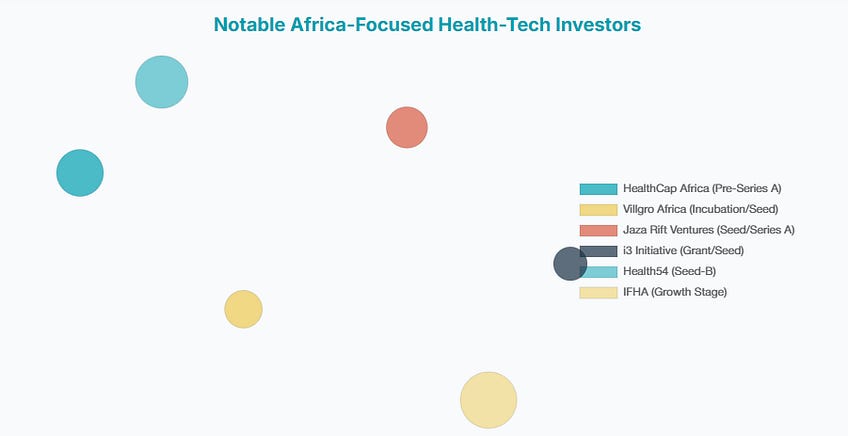 A diverse ecosystem of investors now exists, from firms targeting the fintech-health nexus to those leveraging corporate networks and dedicated deep-tech pipelines.
The Investment Landscape: Navigating a Post-Correction Market
To fully appreciate the resilience and maturation of Africa's health-tech ecosystem, it is essential to analyse the recent investment landscape with nuance. The sector has navigated a turbulent period, moving from the highs of a pandemic-fueled boom through a sharp global venture capital correction, and is now emerging into a more cautious but arguably more sustainable phase. This new environment is characterized by a "flight to quality," where investors are placing more strategic bets on companies with proven business models, leading to a bifurcated market with distinct realities for start-ups at different stages and in different regions.
A Tale of Two Trends: The Correction and the Cautious Rebound
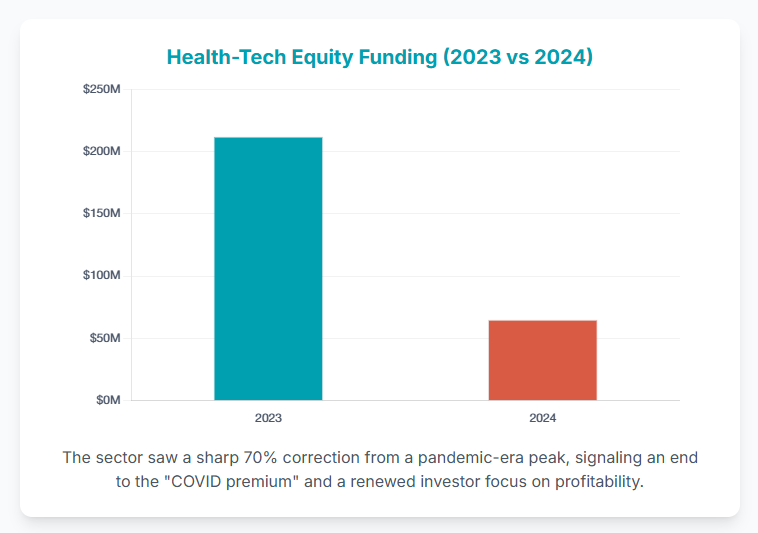
The global venture capital collapse that began in 2022 hit the African continent particularly hard, reversing years of rapid growth. Between 2022 and 2024, the value of VC deals in Africa plummeted by approximately 52%, a steeper decline than in any other region. The health-tech sector, which had been a beneficiary of heightened interest during the COVID-19 pandemic, was not immune. Partech's comprehensive "2024 Africa Tech Venture Capital Report" reveals a staggering
70% year-over-year drop in equity funding for health-tech, which fell from $212 million in 2023 to just $65 million in 2024. The number of health-tech deals also contracted sharply, falling by 40% from 52 to 31 in the same period. This marked a definitive end to the sector's pandemic-era investment boom.
However, the market has since shown clear signs of stabilization and a cautious rebound. Data from the first quarter of 2025 indicated that the steep decline in overall VC funding had slowed significantly, with deal volume down only 3% year-over-year, suggesting the market was finding its floor.
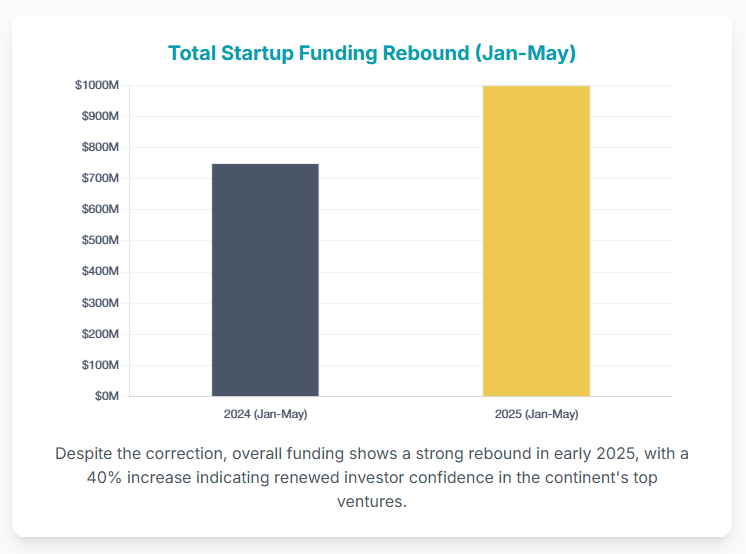
More strikingly, data from Africa: The Big Deal showed that total startup funding in the first five months of 2025 crossed the $1 billion threshold. This represented a 40% increase compared to the $750 million raised during the same period in 2024, signaling a tangible renewal of investor confidence. Health-tech, while still recovering, was highlighted as one of the leading tech-enabled verticals continuing to attract investor attention.
Strategic Implications: A Flight to Quality and a Bifurcated Market
The recent market turbulence was not merely a cyclical dip but a fundamental correction that has reshaped the investment landscape. The "growth at all costs" mindset that characterized the 2021 boom has been replaced by a rigorous focus on fundamentals, leading to a clear "flight to quality." While the total number of funded startups shrank significantly during the downturn, the median deal value continued to climb, indicating that investors are writing larger checks for a smaller number of high-quality, de-risked companies.
This trend has resulted in a bifurcated market with several key characteristics. First, capital has become highly concentrated. Investors are narrowing their focus almost exclusively on the four countries with the most developed startup ecosystems—Egypt, South Africa, Kenya, and Nigeria.
In the first quarter of 2025, this "Big Four" captured a staggering 83% of all startup funding on the continent. Second, the sharp drop in health-tech-specific funding signals that the "pandemic premium" has evaporated. Investors are no longer funding ideas simply because they address a health crisis; they now demand sustainable business models with clear and credible paths to profitability.
Finally, there is a renewed focus on seed-stage deals, which saw a 48% year-on-year increase in Q1 2025. This suggests that while later-stage funding has become more selective, investors are actively seeking to cultivate the next generation of resilient companies from the ground up.
The implication of these shifts is profound. The African health-tech market is maturing and consolidating. For well-run companies with proven, scalable models operating in the major hubs, capital is available, and valuations for top-tier assets remain strong. However, for early-stage ideas in smaller markets or for startups without clear revenue models, the funding winter persists. This new reality will force a greater emphasis on capital efficiency and strong unit economics from day one. It will also likely drive further market consolidation as stronger, better-funded players acquire smaller competitors, ultimately forging a more robust and sustainable ecosystem.
 The Investment Landscape
Conclusion: An Ecosystem Forging Its Own Future
The evidence is clear and compelling: the narrative of African development is undergoing a profound and irreversible transformation. The acute failures of old North-South paradigms, so starkly revealed during the COVID-19 vaccine rollout, did not lead to a crisis of confidence but to a powerful assertion of continental self-reliance. This is no longer a distant aspiration or a policy talking point; it is a tangible reality being built in real-time across the continent.
This new era is visible in the deliberate, policy-driven innovation architecture of Rwanda, which has turned the nation into a live laboratory for digital health at scale. It is evident in the platform economics of Ghana, where a ubiquitous fintech infrastructure has become the launchpad for a new generation of health services. And it is embodied in the deep-tech ambitions of Egypt, which is building a sovereign AI capability to secure its long-term health and economic future.
This self-reliance is proven by the successful cross-continental journeys of a new class of pan-African companies. Innovators like Helium Health and mPharma are not just adapting foreign models; they are creating sophisticated, hybrid business strategies, blending software with finance, and digital platforms with physical operations, that are uniquely built for Africa, by Africans. Their expansion is a testament to the power of South-South learning, where a solution perfected in Lagos or Accra finds fertile ground in Kampala and Abidjan.
This entire movement is being capitalized by an increasingly sophisticated local investment community. African-led VCs like HealthCap Africa, Villgro Africa, and Jaza Rift Ventures are providing the "smart capital" essential for sustainable growth, offering not just money, but the deep contextual wisdom, patient timelines, and structural support needed to build lasting enterprises in complex markets.
As reports from institutions like the New Partnership for Africa's Development (NEPAD) and McKinsey confirm, the continent is demonstrating a remarkable ability to leverage technology to leapfrog legacy infrastructure and development pathways. The health-tech ecosystem is at the absolute vanguard of this movement.
Africa is no longer just a market to be served or a problem to be solved by others. It is emerging as a dynamic source of innovation, creating resilient, collaborative, and scalable models for healthcare delivery that hold valuable lessons for the entire world. The future of health is not just being imported into Africa; it is being built here.
The newsletter is free and open to anyone who is interested in digital health. All you need to do is to subscribe to my newsletter at dhdigest.substack.com🔔 to stay informed and get the latest updates delivered straight to your inbox.
Don’t miss this chance to join the digital health revolution and take your health, your business, or your career to the next level.