The COVID-19 pandemic served as a global stress test for health systems, revealing deep-seated fragmentation while simultaneously catalyzing a decade's worth of digital transformation in a matter of months.
From this crucible, the concept of Digital Public Infrastructure (DPI) has emerged as a paradigm-shifting approach, moving beyond siloed applications to establish foundational, society-wide digital "utilities."
DPI is not a single technology but rather a network of shared digital systems that function like the essential infrastructure of the physical world, such as roads and electricity grids, but for the digital era. It is the "digital plumbing" or "intermediate layer" that enables the seamless delivery of services across all sectors of society.
This article provides an expert-level analysis of the DPI-for-Health model, arguing that its adoption is essential for building the resilient, equitable, and people-centric health systems of the 21st century.
It will deconstruct the architecture of DPI for Health, articulate its compelling value proposition, and analyze global implementation models through detailed case studies of Estonia, India, and Nigeria.
Furthermore, this analysis will dissect the critical challenges that impede progress, interoperability, governance, and vendor lock-in, and conclude by charting a strategic path forward for policymakers and health leaders seeking to harness this transformative potential.
This piece will begin by defining the core framework of DPI, explore its multifaceted benefits, examine real-world applications, tackle the primary obstacles to implementation, and finally, offer actionable recommendations for a global digital health transformation.
Deconstructing Digital Public Infrastructure for Health
What is DPI?
Digital Public Infrastructure (DPI) refers to a set of shared, secure, and interoperable digital systems, often built on open standards and specifications, designed to provide equitable access to public and private services at a societal scale.
The concept, which gained significant global prominence during India's G20 presidency, represents a fundamental shift in how governments approach digitalization, focusing on building foundational capabilities rather than disparate, single-purpose applications.
At its core, this cross-sectoral infrastructure is typically composed of three main pillars that enable the vast majority of digital transactions and services :
1. Digital Identity
This is the bedrock of trust in the digital ecosystem. A digital ID system provides a verifiable and secure way for individuals and organizations to prove who they are when accessing services.
Examples like India's Aadhaar and Estonia's eID demonstrate how a unique digital identity can unlock access to finance, education, and healthcare, forming the foundational layer upon which secure interactions are built.
2. Digital Payments
An interoperable, real-time payments network allows individuals, businesses, and governments to send and receive money instantly and at low cost, irrespective of the financial institutions they use.
Systems like India's Unified Payments Interface (UPI) and Brazil's Pix have revolutionized their respective economies by fostering unprecedented financial inclusion and streamlining both commercial and government-to-person (G2P) transactions.
3. Data Exchange
A secure and standardized data exchange layer enables the seamless flow of information between different public and private sector entities, but only with the consent of the data owner.
This pillar is critical for breaking down the data silos that have long plagued public service delivery, allowing for integrated and citizen-centric services. Estonia's X-Road platform is a pioneering example of a data exchange layer that underpins the nation's entire e-governance framework.
For these pillars to function effectively as public infrastructure, they must embody several key characteristics. A well-designed DPI is inclusive, ensuring near-universal access; foundational, allowing any entity to build new services on top of it; interoperable, based on open standards that ensure different systems can communicate; publicly accountable, operating under transparent governance mechanisms; and supportive of local sovereignty, giving countries control over their own digital destiny.
It is crucial to understand that the "public" in DPI refers to its role in serving the public benefit and the common good, not necessarily exclusive government ownership or construction; private sector actors often play a vital role in building and operating components of the DPI ecosystem.
The DPI-for-Health Model
Recognizing the transformative potential of this approach, global health leaders, spearheaded by the World Health Organization (WHO) and the International Telecommunication Union (ITU), are now working to define a reference architecture specifically for DPI for Health.
This initiative is a direct response to the long history of fragmented, project-based digital health interventions that have failed to scale or achieve long-term sustainability. The goal is to create a blueprint that catalyzes locally owned, integrated, and interoperable national digital health ecosystems.
This architecture is best understood as a multi-layered stack, a design that promotes modularity, reusability, and scalability. Each layer builds upon the services provided by the one below it, creating a cohesive and efficient system.
Layer 1: Foundational DPI
At the base of the health-specific architecture lies the cross-sectoral DPI discussed previously. This layer provides the essential, economy-wide services that are prerequisites for any modern digital system.
The WHO-ITU conceptual diagram explicitly identifies "Trust" as the core service provided by this layer, a function primarily delivered through robust digital identity and secure authentication mechanisms. This foundational infrastructure provides the secure and standardized environment upon which all health-specific functionalities are built.
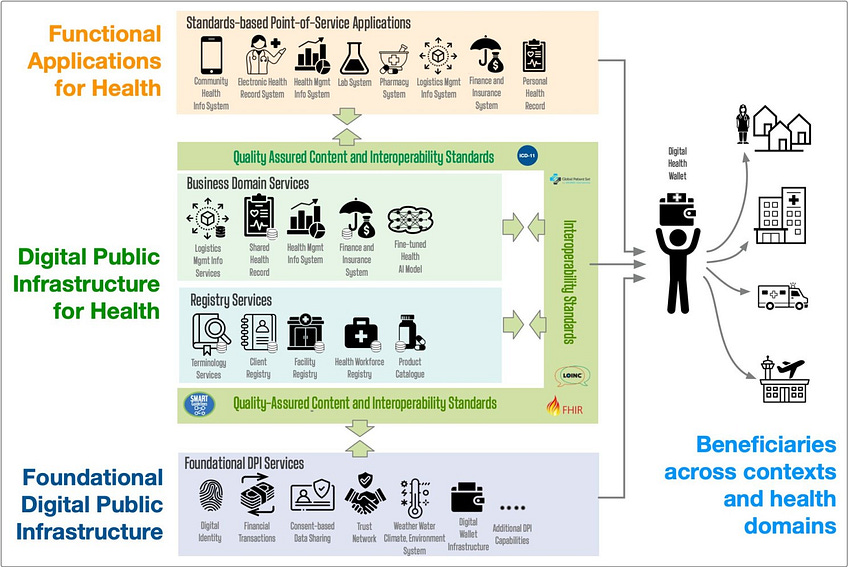 WHO - ITU Conceptual Diagram
Layer 2: Digital Public Infrastructure for Health (DPI for Health)
Sitting atop the foundational layer, this middle tier consists of components specifically tailored for the health sector. It leverages the underlying identity and trust services to provide shared, health-specific functionalities. This layer is further divided into two key sub-components :
1.Registry Services
These are the authoritative sources of truth for the core entities within a health system. They include patient registries (to uniquely identify individuals across care settings), health workforce registries (to manage and verify credentials of providers), and facility registries (to maintain a definitive list of hospitals, clinics, and labs). These registries are the backbone of a connected health system, ensuring data accuracy and enabling continuity of care.
2. Business Domain Services
These are shared software components that handle common, repeatable business processes within the health sector. The WHO-ITU diagram provides "Logistics" as a prime example, pointing to services for managing the supply chain of medicines, vaccines, and other essential health commodities.
Other examples could include standardized modules for appointment scheduling, insurance claims processing, or public health surveillance reporting. By offering these as shared services, the system avoids redundant development efforts across different applications.
Layer 3: Functional Applications for Health
This is the top, user-facing layer of the architecture. It comprises the point-of-service applications that clinicians, administrators, and patients interact with daily.
Examples include Electronic Health Record (EHR) systems, digital health wallets for storing credentials and health information, health insurance management platforms, and specialized logistics systems.
A critical feature of this layer is that the applications are "standards-based," meaning they are designed to seamlessly connect to and consume the services offered by the lower layers. They are the "storefronts" that make the underlying infrastructure useful to end-users.
The entire architectural stack is held together by a critical, pervasive element: "Quality Assured Content and Interoperability Standards". This "glue" consists of agreed-upon rules, protocols, and vocabularies (such as HL7 FHIR, openEHR, and OMOP) that dictate how data is structured and exchanged between the different layers and components.
Without these standards, the layers cannot communicate, data remains trapped in silos, and the system fails to deliver on its promise of seamless integration. The repeated emphasis on standards in the WHO framework underscores that interoperability is not an afterthought but the central design principle of the entire model.
The elegance of this layered architecture lies in its strategic response to the historical failures of monolithic, siloed health IT projects. It deliberately separates the foundational "plumbing" (like identity and payments) from the health-specific "services" (like registries) and the user-facing "applications" (like EHRs).
This separation fosters specialization and market dynamism. Governments, or public-private partnerships, can focus on providing the robust, reliable, and highly regulated foundational and health-specific layers.
This, in turn, creates a stable and predictable environment that lowers the barrier to entry for private companies, startups, and public entities to innovate at the application layer. They can develop new and competitive health solutions without the prohibitive cost and complexity of building their own identity, payment, or registry systems from scratch.
In this way, the architecture itself becomes a strategic tool to cultivate a vibrant and competitive national digital health ecosystem, shifting the paradigm from procuring individual, closed-off products to nurturing an open, integrated platform.
Why DPI is a Game-Changer for Health Systems
Core Benefits for Stakeholders
The global push for DPI in health is driven by a compelling value proposition that extends tangible benefits to every stakeholder in the healthcare ecosystem. This is not merely a technological upgrade but a fundamental re-engineering of how health services are delivered, managed, and experienced.
For Patients & Citizens
The most profound impact of DPI is on the individual. It facilitates a seamless exchange of information between different healthcare providers, ensuring that a patient's complete medical history can follow them wherever they seek care. This enhances the continuity and quality of care, reducing the risk of medical errors, eliminating redundant tests, and supporting more accurate diagnoses.
Furthermore, well-designed DPI frameworks can empower individuals with ownership and control over their own health data. By providing secure portals and consent mechanisms, these systems allow patients to decide who can access their information and for what purpose, fostering a sense of agency and building trust in the digital health system.
For Health Workers
Frontline health workers, who are often overburdened with administrative tasks, stand to benefit significantly. By automating routine processes, standardizing data entry, and streamlining workflows, DPI can drastically reduce the administrative burden on clinicians. This frees up their valuable time to focus on what they do best: providing direct patient care.
This is a critical advantage in the face of a global health workforce shortage. Moreover, by providing access to a comprehensive and longitudinal patient record at the point of care, DPI-enabled systems provide powerful clinical decision support. This improves clinical decision-making, helps in adhering to evidence-based guidelines, and ultimately reduces the likelihood of medical errors.
For Health Systems & Policymakers
At a systemic level, the benefits are transformative. DPI drives efficiency, affordability, and significant cost savings by optimizing resource utilization, reducing the duplication of effort, and streamlining complex processes like supply chain management for essential medicines.
Global estimates suggest that achieving full interoperability alone could save national health systems billions of dollars annually through greater administrative efficiency and fewer redundant procedures.
The availability of standardized, high-quality data from an integrated system strengthens regulation and oversight, allowing authorities to better monitor the performance of the health system, ensure patient safety, and enforce compliance with quality standards. This rich data stream also enables truly data-driven policymaking and resource allocation.
As the COVID-19 pandemic demonstrated, countries with more integrated digital systems were better able to track disease spread, manage resources, and implement effective public health responses.
Finally, by enhancing data availability and standardization, DPI can positively influence health financing models, making insurance and payment processes more transparent and efficient.
Accelerating Global Development Goals
The impact of DPI for Health extends far beyond the confines of the health sector. Major international development organizations, including the United Nations Development Programme (UNDP) and the Bill & Melinda Gates Foundation, view DPI as a critical accelerator for achieving the 2030 Agenda for Sustainable Development, particularly SDG 3 (Good Health and Well-being).
The benefits are inherently cross-sectoral. A robust DPI for Health intersects with and supports progress on numerous other goals. For example, by facilitating conditional cash transfers for health-positive behaviors or by ensuring women have secure access to maternal health services, it contributes to poverty reduction (SDG 1) and gender equality (SDG 5). The development of a digital health ecosystem also spurs innovation and creates economic opportunities, contributing to decent work and economic growth (SDG 8).
Perhaps most critically, DPI builds national resilience. The experience of the COVID-19 crisis starkly illustrated this point: countries that had invested in foundational DPI were able to pivot more quickly to deliver emergency social protection payments and essential health services, demonstrating the infrastructure's vital role in enabling governments to function effectively during a crisis.
The true value of DPI for Health is not merely the sum of its parts; it is exponential. While a standalone digital ID system, a separate payment network, or an isolated EHR application each offers incremental benefits, their true power is unleashed only when they interact within a unified, standards-based framework.
Consider the full chain of events: a patient uses their digital ID (Pillar 1) to securely log into their personal health wallet (Application Layer). This wallet pulls their complete, longitudinal health record from multiple providers via the data exchange layer (Pillar 3). Following a telehealth consultation, the patient uses an integrated payment system (Pillar 2) to pay for a prescription, or perhaps receives a direct benefit transfer from the government as an incentive for completing a vaccination schedule. The aggregated, anonymized data from millions of such transactions then provides policymakers with real-time insights to manage public health crises or allocate resources more effectively.
This seamless flow demonstrates that the transformative value lies not in the individual components, but in their secure, standardized, and orchestrated interaction. This network effect is the core economic and social argument for pursuing a holistic DPI strategy over piecemeal digitization. It fundamentally shifts the objective from simply "buying a digital product" to strategically "building a national digital ecosystem."
Case Studies in DPI for Health Implementation
The theoretical promise of DPI for Health is being validated in diverse national contexts around the world. An examination of these real-world implementations, from mature, highly integrated systems to emerging models in resource-constrained settings, provides invaluable lessons on strategic design, success factors, and persistent challenges.
There is no "one-size-fits-all" approach; context is paramount.
Estonia: The Mature Model of Interoperability and Trust
Context: In the wake of regaining independence in the 1990s, Estonia made a strategic decision to build a digital-first nation from the ground up, leapfrogging legacy technologies to invest in a comprehensive e-governance system. This farsighted political vision and sustained investment created the ideal foundation for one of the world's most advanced and integrated e-health systems.
Core Component: The heart of Estonia's digital state is X-Road. It is crucial to understand that X-Road is not a massive, centralized database. Instead, it is a secure data exchange layer, an "information highway", that allows hundreds of separate public and private databases to communicate with one another in a standardized, secure, and highly controlled manner.
Data remains in its original location, but X-Road provides the secure pathway for it to be queried and shared. Every single transaction is timestamped, digitally signed, and logged, creating an immutable audit trail that allows citizens to see exactly who has accessed their data and when. This radical transparency is the cornerstone of the system's high level of public trust.
Health Implementation & Outcomes
The X-Road infrastructure enables a suite of sophisticated e-health services:
The Estonian National Health Information System (ENHIS) integrates data from every healthcare provider in the country into a single, comprehensive electronic health record for each citizen, accessible to authorized providers and to the citizens themselves through the secure e-Patient Portal.
The e-Prescription system, launched in 2010, now handles over 99.9% of all prescriptions in the country. A doctor issues a prescription digitally, and it is instantly available in a central repository. The patient can then go to any pharmacy in Estonia, present their digital ID, and have the prescription filled. This paperless system saves immense time, reduces errors, and allows for better tracking of medication adherence.
The system is designed for cross-border interoperability. Through the European eHealth Digital Service Infrastructure (eHDSI), an Estonian citizen can fill an e-prescription in Finland or Portugal, a critical feature for a mobile European population.
Secondary use of data is a built-in feature. Anonymized health data is used for public health research, statistics, and policy planning. The Social Insurance Board can also securely access relevant health data to make evidence-based decisions on disability benefits.
Key Success Factors
Estonia's success can be attributed to a confluence of factors: clear and consistent governance, a robust legal framework, a universal and mandatory digital ID (the eID card) that serves as the key to all digital services, a mature technology ecosystem, and, above all, a relentless focus on security and transparency that has earned deep and lasting public trust.
India: The Paradigm of Population-Scale Implementation
Context: India's DPI journey is defined by its unprecedented scale. It began with the launch of the Aadhaar biometric digital ID system, which has enrolled over a billion people and is now the world's largest such program. Aadhaar became the foundational identity layer for the "India Stack," a comprehensive set of open APIs that also includes the revolutionary UPI payments system and data-sharing frameworks.
Core Component: Building on this foundation, the Indian government launched the Ayushman Bharat Digital Mission (ABDM). The mission's goal is to create a national digital health ecosystem by leveraging the Aadhaar ID system. It aims to provide every citizen with a unique Ayushman Bharat Health Account (ABHA) number, which acts as a portable and interoperable health identifier.
Health Implementation & Outcomes
The Goal: The central objective of ABDM is to create a longitudinal health record for every citizen. This record, linked via their ABHA number, would be accessible to different healthcare providers with the patient's consent, thereby improving continuity of care and eliminating the need for patients to carry bulky physical files of reports and prescriptions from one doctor to another.
Current Use Cases: Aadhaar is already deeply integrated into the health sector. It is the primary means of identity verification for beneficiaries of the massive Ayushman Bharat PM-JAY health insurance scheme and was used for the Co-WIN COVID-19 vaccination platform. It also enables Direct Benefit Transfers (DBT), where government funds for health-related programs, such as financial support for TB patients or incentives for institutional deliveries, are sent directly to beneficiaries' Aadhaar-linked bank accounts, reducing corruption and leakages.
The Potential: The sheer scale of the data that could be generated by a fully implemented ABDM is staggering. If managed correctly, it could revolutionize public health management, enable cutting-edge medical research, and provide policymakers with unparalleled insights for data-driven decision-making.
Challenges and Criticisms: Despite its immense potential, the Aadhaar-linked health ecosystem faces significant and valid criticism, primarily centered on:
Privacy and Security: The prospect of linking highly sensitive personal health data to a centralized, state-controlled biometric ID database raises profound privacy concerns. Civil society groups and privacy advocates worry about the potential for data breaches and the misuse of data, especially for individuals with stigmatizing conditions like mental health disorders or HIV/AIDS, where confidentiality is paramount.
Exclusion: The heavy reliance on a single ID system creates a risk of exclusion. Marginalized individuals who may lack the necessary documentation to obtain an Aadhaar card, or who face challenges with biometric authentication (such as the elderly or manual laborers with worn fingerprints), could be denied access to essential health services.
Surveillance: Perhaps the most serious concern is the potential for such a powerful, integrated system to be used as a tool for state surveillance and social control, fundamentally altering the relationship between the citizen and the state.
Nigeria (Niger State): The Emerging Model in a Low-Resource Context
Context: Nigeria's health system, like those in many low- and middle-income countries (LMICs), has long been characterized by systemic challenges, including under-resourcing, fragmentation, and a heavy reliance on donor-funded projects that are often uncoordinated and unsustainable. The level of digital health maturity varies dramatically across its 36 states, creating a patchwork of capabilities.
Core Problem-Solving: The digital health initiative in Niger State serves as a powerful case study of how a DPI approach can be applied to solve fundamental, on-the-ground problems, even in a resource-constrained environment.
Health Implementation & Outcome
The Challenge: Before the initiative, the state's healthcare facilities relied on an analogue, paper-based system for patient records. This led to a cascade of severe problems: frequently lost patient files, which caused dangerous delays in care and sometimes had fatal consequences; a lack of patient privacy; and opportunities for administrative corruption.
The Solution: The state government introduced a unified health card linked to the national digital ID, the National Identification Number (NIN). This simple intervention means a patient's record can be created once and accessed digitally across any of the state's secondary health facilities, effectively eliminating the "lost file" problem.
Tangible Impact: The outcomes have been direct and impactful. The system has streamlined patient information management, improved the process for medical referrals between facilities, and even functions as a digital wallet, allowing patients to use the card for digital payments for medicines and services. In a broader context, the state's use of biometrics for its payroll system has helped to identify and remove approximately 15,000 "ghost workers," saving the government billions of Naira that can be redirected to public services like health.
Broader African Context
The Niger State case reflects a continent-wide movement. Africa is already a global leader in mobile money, a key DPI component, with the continent handling 70% of the world's mobile money transactions.
High-level initiatives like the African Union's Digital Transformation Strategy and the development of regional data policy frameworks are laying the political and regulatory groundwork for more integrated DPI systems.
However, formidable challenges remain, including vast gaps in internet connectivity and power infrastructure, the need for sustainable financing models, and the ongoing struggle to build strong, harmonized governance structures.
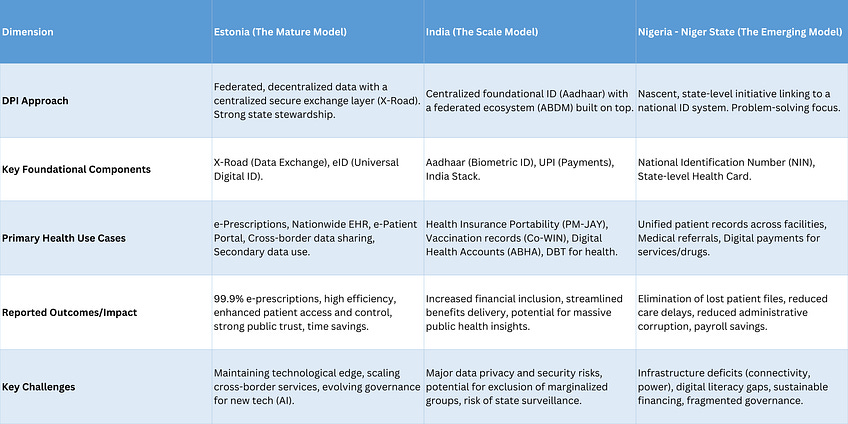 Table 1: Summary of Case Studies
Critical Challenges and Strategic Mitigations
While the potential of DPI for Health is immense, the path to successful implementation is fraught with significant challenges. These obstacles are not merely technical; they are deeply rooted in organizational inertia, financial constraints, and complex governance issues. Addressing them requires a holistic, socio-technical strategy.
The Interoperability Impasse: Beyond Technical Standards
The Problem: The healthcare sector has historically lagged far behind other industries, like banking and finance, in achieving data interoperability. Health data remains fragmented, trapped in disconnected "data silos" created by a combination of outdated legacy systems, proprietary software formats, and organizational resistance to sharing.
This lack of communication between systems prevents the creation of a holistic, longitudinal patient record, leading to gross inefficiencies, duplicated tests, and an increased risk of medical errors.
The Challenge is Socio-Technical: The adoption of technical standards for data exchange, such as HL7 FHIR (Fast Healthcare Interoperability Resources), openEHR, and OMOP, is a necessary but insufficient condition for solving the interoperability puzzle. The most formidable barriers are often organizational and financial.
These include the lack of a universally adopted, standardized medical terminology; inconsistent data entry practices by clinicians; the prohibitive cost and complexity of overhauling legacy EHR systems; and a fundamental lack of business or financial incentives for healthcare providers to share their data with potential competitors.
Levels of Interoperability: Achieving true interoperability is a multi-stage journey. It begins with foundational interoperability (the ability for one system to securely send data to another), progresses to structural interoperability (ensuring the data format is understood), then to semantic interoperability (ensuring the meaning of the data is commonly understood, e.g., a lab code means the same thing in every system), and finally culminates in organizational interoperability, where aligned governance, policies, and legal agreements enable seamless and trusted data sharing across institutional and regional boundaries.
Building Trust Through Data Protection
Data as a Strategic Asset: In the digital age, health data is one of a nation's most valuable strategic assets. Like any valuable asset, it must be managed and governed with extreme care. The core purpose of a data governance framework is to reconcile the immense public health benefits that can be derived from the use and reuse of data with the significant potential for its abuse.
The Trust Imperative: Public trust is the essential currency of any successful DPI. If citizens do not trust that their most sensitive personal information will be protected, they will refuse to participate, and the entire system will collapse. This trust is not granted automatically; it must be earned through a robust and transparent governance framework built on several key principles:
- Clear Legal Frameworks: The foundation of trust is the law. Nations must enact and rigorously enforce comprehensive data protection legislation, akin to Europe's GDPR, that establishes clear rights for individuals and clear responsibilities for data custodians.
- Citizen-Centric Data Ownership: A fundamental principle of modern data governance is that the individual owns their data. DPI systems must be designed to empower citizens with meaningful control, giving them the explicit right to grant or refuse consent for the collection and use of their data, the right to access their own records, and the right to rectify any inaccuracies.
- Transparency and Accountability: The operations of the system must be transparent. Citizens should be able to easily see how their data is being used and by whom. There must also be clear lines of accountability and swift, meaningful recourse in the event of a data breach or misuse. Estonia's X-Road system, which creates an immutable log of every single data access request that the citizen can review, serves as a global benchmark for this kind of transparency.
The Vendor Lock-in Trap: A Threat to Digital Sovereignty
The Problem: A pervasive and costly problem in health IT is "vendor lock-in." This occurs when a healthcare organization or an entire country becomes overly dependent on a single vendor's proprietary technology, particularly for core systems like EHRs.
Because these systems often use closed, non-standard formats and are not designed to be interoperable, it becomes prohibitively expensive and technically nightmarish to switch to a different vendor or to integrate innovative new tools from other companies. This stifles competition, inflates costs, and forces organizations to adopt inefficient workarounds. This is not just a financial problem; it represents a fundamental loss of digital sovereignty, where a country's digital destiny is dictated by the business interests of a foreign technology vendor.
The Strategic Antidote: Openness: The most effective strategy to prevent and escape the vendor lock-in trap is a decisive and comprehensive commitment to openness.
Open Standards: Mandating the use of open interoperability standards like HL7 FHIR forces all vendors to build products that can communicate with each other, creating a level playing field and giving customers the freedom to choose the best-in-breed solutions without fear of being trapped.
Open-Source Software (OSS): Adopting open-source software for core DPI components, such as MOSIP for digital identity or Mojaloop for payments, is a game-changer. It gives countries complete ownership and control over their core infrastructure. They can freely access, modify, and adapt the software to their specific needs, breaking the cycle of dependency.
Building In-House Capacity: An "open-source first" policy does more than just provide free software; it fosters a culture of local skills development. By investing in the capacity of local teams to implement, maintain, and customize open-source solutions, countries can build long-term technological self-sufficiency and reduce their reliance on expensive external consultants.
Modernizing Procurement: Governments must fundamentally rethink how they procure digital technology. The traditional model of writing rigid specifications for a single, monolithic product is ill-suited for the dynamic world of DPI. Procurement policies must become more agile, focusing on acquiring flexible services, supporting the integration of open-source components, and prioritizing long-term value and adaptability over short-term cost.
The LMIC Context: Overcoming Foundational Hurdles
The Digital Divide: While the challenges above are universal, they are acutely amplified in Low- and Middle-Income Countries (LMICs). The most significant barrier is the foundational infrastructure gap, often referred to as the digital divide. This includes limited and unreliable internet connectivity, especially in rural areas; inconsistent electricity supply; and the high cost of data and internet-enabled devices, which puts them out of reach for the poorest populations.
Systemic Challenges: Beyond the infrastructure deficit, LMICs grapple with a "polycrisis" of interconnected systemic challenges that hinder digital health transformation:
- Sustainable Funding: Many digital health initiatives in LMICs are heavily reliant on short-term, project-based funding from international donors. This often leads to a lack of long-term sustainability and local ownership, with promising pilots fizzling out once the external funding cycle ends.
- Workforce Capacity: A chronic shortage of trained healthcare workers is compounded by a widespread lack of digital literacy among both the general population and the health workforce itself. There is also a critical scarcity of local technical experts needed to design, manage, and maintain complex digital systems.
- Governance and Regulation: In many LMICs, the legal and regulatory frameworks for digital health and data protection are either nascent or fragmented. This creates legal uncertainty, stifles innovation, and leaves citizens' data vulnerable.
- A Fragmented Ecosystem: The history of digital health in many developing countries is one of "pilotitis", a landscape littered with countless small-scale, uncoordinated, and often duplicative digital health projects funded by different donors with different agendas. This has resulted in a patchwork of non-interoperable systems that are impossible to scale into a cohesive national framework.
These four critical challenges, interoperability, governance, vendor lock-in, and the specific context of LMICs, are not isolated issues. They are deeply intertwined, forming a complex web that can stall progress.
For example, a country seeking to solve its interoperability problem (Challenge 1) might decide to adopt open standards. This move is also a direct strategy to combat vendor lock-in (Challenge 3). However, for these open standards to be effective, there must be clear rules governing data sharing, which requires a strong data governance framework (Challenge 2). Without this governance, providers and patients will not trust the system enough to participate. For an LMIC (Challenge 4), this entire process is exponentially harder.
It may lack the financial resources to overhaul legacy systems, the local technical expertise to implement open-source solutions, and the political capital to push through robust data protection laws. Its reliance on donor funding might even inadvertently push it toward proprietary, locked-in solutions that exacerbate the other problems.
This demonstrates that a successful DPI strategy cannot be a linear, siloed effort. It demands a holistic and integrated approach that simultaneously invests in open technology, builds comprehensive governance frameworks, and focuses on sustainable, context-appropriate solutions. DPI, therefore, is fundamentally a governance and national strategy challenge, not merely a technical one.
The Path Forward: Charting a Course for Global Digital Health Transformation
The journey toward a digitally transformed global health landscape requires a concerted and strategic effort from nations and the international community. The path forward is not about finding a single technological fix, but about fostering a new mindset, building collaborative ecosystems, and committing to long-term, foundational investments.
Adopting a "DPI-First" National Strategy
The single most important step for any country embarking on this journey is to adopt a "DPI-first" mindset in its national digital health strategy. This represents a fundamental shift in priorities. For decades, digital health investments have often been vertical and application-focused, leading to the fragmented landscape we see today.
A DPI-first approach reverses this logic. It prioritizes investment in the foundational, horizontal layers of the digital infrastructure, the "digital roads", before funding the proliferation of individual "digital cars".
This requires robust, long-term strategic planning. A national digital health strategy must be more than a document; it must be a comprehensive roadmap that integrates financial, organizational, human, and technological resources, with DPI as its central, organizing principle. This cannot be achieved without sustained, high-level political commitment and leadership that champions the vision and drives the necessary reforms across government and society.
The Role of the Global Collaborative Ecosystem
No country needs to embark on this journey alone. In a significant and positive development, the global health community is converging around DPI as the primary model for digital transformation. This has given rise to a powerful ecosystem of support that nations can and should leverage.
The Global Initiative on Digital Health (GIDH): Launched by the WHO in partnership with key organizations like the ITU, the GIDH is designed to function as a "network of networks" to support countries in their digital health transformation journeys. Its core purpose is to align resources, converge efforts to avoid fragmentation, and serve as a trusted source of quality-assured standards, tools, and knowledge to support country-led initiatives.
The GIDH's ongoing call for technical experts to help develop a comprehensive DPI Reference Architecture Toolkit is a concrete example of this collaborative effort to create a global public good that can guide and accelerate national implementations.
Key International Partners: A host of other international partners play critical roles in this ecosystem:
- The World Bank : Through its influential Identification for Development (ID4D) and Digitizing Government-to-Person Payments (G2Px) initiatives, the World Bank provides critical financing and technical assistance to help countries build the foundational identity and payment layers of DPI. Its approach rightly emphasizes a focus on achieving tangible development outcomes, not just deploying technology for its own sake.
- UNDP : The UNDP plays a vital role in stewarding strategic initiatives at the country level, providing direct support to governments, and, crucially, advocating for a human rights-based approach to DPI. Its work on developing a Universal DPI Safeguards Framework is essential for ensuring that these systems are built to be safe, inclusive, and trustworthy.
- Other Stakeholders: The ecosystem is further enriched by a vibrant community of philanthropic organizations (such as the Gates Foundation and Omidyar Network ), multi-stakeholder alliances (like the Digital Public Goods Alliance ), and the open-source communities that build and maintain the actual software components (such as Modular Open Source Identity Platform (MOSIP) for identity and Mojaloop Foundation).
This convergence of global actors around the common concept of DPI is perhaps the single most important enabler for its future success. It provides the political momentum, financial resources, and shared technical guidance necessary for countries to overcome the immense challenges of digital transformation, especially for LMICs. It signals a maturation of the entire global digital health field, a move away from the uncoordinated "Wild West" of the past toward a more structured, collaborative, and standards-based future.
Concluding Vision: From Technology to Transformation
It is essential to reiterate that building Digital Public Infrastructure for Health is not merely a technological project. It is a complex socio-technical undertaking that requires a delicate and deliberate blending of technology, policy, governance, and human capacity building. The technology provides the tools, but it is the governance that provides the trust, and it is the people who ultimately deliver the value.
The ultimate goal is to create national digital ecosystems that are inclusive, trusted, and sustainable. It is about laying the digital tracks today that will define the shape and function of our shared health infrastructure for generations to come.
By embracing a holistic, foundational, and collaborative DPI approach, nations can finally move beyond the fragmented and inefficient systems of the past. They can build a true digital backbone for their health systems, one that is resilient in the face of crises, responsive to the needs of its people, and capable of delivering on the universal promise of health and well-being for all. This is not just another IT project; it is one of the most fundamental and consequential public investments of the 21st century.
📅 Want to go deeper? Join us at the upcoming Africa HealthTech Summit - #AHTS25 in Kigali, October 13–15, for in-depth discussions on DPI in Health.