
Three years ago, asking whether FHIR would become the dominant health data exchange standard was a legitimate debate. Today, 80% of countries with electronic health data regulations specifically mandate or advise FHIR, up from 56% in 2023. The debate is over. The implementation challenge is not.
Governments on every continent are writing FHIR into law, building national implementation guides, and setting compliance deadlines. What is actually driving this convergence, and what does it mean for the countries and institutions still figuring out where to start?
The regulatory wave
The United States set the pace. The CMS Interoperability and Prior Authorization Final Rule requires Medicare Advantage organizations, state Medicaid programs, and Qualified Health Plan issuers to implement FHIR-based APIs for electronic health data exchange, with key requirements taking effect January 1, 2026. The Trusted Exchange Framework and Common Agreement (TEFCA) pushes further: by July 2026, participating networks must expose data via FHIR APIs aligned with the US Core Implementation Guide and USCDI v3.
Europe followed with a bolder structural move. The European Health Data Space (EHDS) Regulation, which entered into force in March 2025, mandates the European Electronic Health Record Exchange Format (EEHRxF) built on FHIR specifications as a legal requirement across all EU member states. Implementing acts expected by March 2027 will define precise technical and semantic requirements for compliance. In November 2025, HL7 Europe published three new FHIR Implementation Guides covering R4, R5, and Extensions, giving member states a harmonized technical baseline.
Saudi Arabia and Estonia are enforcing national deadlines for FHIR integration. India’s Ayushman Bharat Digital Mission adopted FHIR for its health data exchange layer. Australia’s My Health Record ecosystem runs on FHIR. The pattern is consistent: governments are choosing FHIR not because of technical elegance alone, but because no alternative offers the same combination of open licensing, vendor neutrality, and a global community maintaining the standard.
Why FHIR is winning the standards race
Previous health data standards required organizations to agree on entire message structures before exchanging a single data element. FHIR flipped this model. Its resource-based architecture lets systems exchange discrete, well-defined data objects (a Patient, an Observation, a MedicationRequest) over standard web protocols. A developer who knows REST APIs already understands 80% of how FHIR works.
This design choice reduced the barrier to entry dramatically. HL7 v2 dominated for decades because it was already deployed, not because it was easy to implement. FHIR is winning because it is both deployable and implementable by a broader workforce.
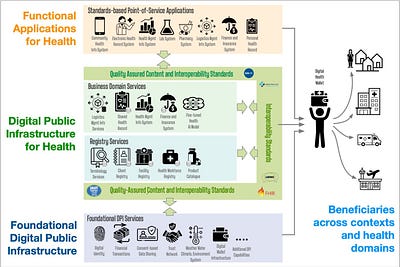
WHO recognized this advantage and positioned FHIR as the foundation for its SMART Guidelines initiative, which translates clinical recommendations into machine-readable, executable digital health content. The ambition: a country implementing WHO’s immunization guidelines should be able to deploy a FHIR-based decision support module directly into its health information systems, without rebuilding from scratch.
The enforcement gap
Here is where the global picture gets complicated. While 80% of countries with regulations reference FHIR, the gap between policy intent and operational reality remains wide.
A 2025 survey by HL7 International found only 11 respondents reporting financial penalties for non-compliance with FHIR mandates, even among the 37 countries with published compliance deadlines. The mandates exist. The enforcement teeth, in most places, do not.
This gap is especially visible in Africa. Countries including South Africa, Kenya, Rwanda, Uganda, Ghana, and Nigeria have explicitly prioritized interoperability through national eHealth strategies aligned with HL7 and FHIR frameworks. The “Africa on FHIR” initiative, led by HELINA in collaboration with Africa CDC, HL7 International, and WHO, is building capacity for FHIR adoption across the continent. The Africa Standards and Interoperability Lab (SIL-Africa), hosted in Rwanda, supports development, testing, and scaling of interoperable digital health solutions.
The challenge: many national strategies lack detailed implementation roadmaps, financing mechanisms, and workforce investment plans. Countries are investing in digital health solutions while facing system fragmentation, limited interoperability, and a shortage of professionals trained in FHIR. The policy commitment is real. The implementation pipeline is thin.
What FHIR R6 changes
The next version of the standard, FHIR R6, is expected to publish in late 2026 or 2027. Its first normative ballot opened in January 2026, with a second ballot opening July 2026.
R6 represents a maturity milestone. It moves the majority of commonly used clinical and administrative resources to normative status, meaning once you build against R6 normative resources, those APIs will not face breaking changes in subsequent releases. For organizations delaying adoption while waiting for stability, R6 removes their strongest argument for waiting.
R6 also introduces a new publishing model: immature resources move out of the core specification into incubator implementation guides, keeping the core lean and stable. Backward compatibility with R4’s normative resources is an explicit design goal, so a valid R4 Patient resource remains processable by an R6 server without modification.
For countries building their first national implementation guides today, R6 offers a more stable foundation than any previous release.
What this means for decision makers
If you are leading digital health strategy at a national or institutional level, three realities demand your attention.
First, FHIR adoption is no longer optional for any country planning to participate in cross-border health data exchange. The EU, the U.S., and major economies across Asia and the Middle East have made their choice. Countries without FHIR strategies will find themselves isolated from the emerging global health data infrastructure.
Second, mandating FHIR in a national strategy document is necessary but insufficient. The countries making real progress are investing in three things simultaneously: national FHIR implementation guides tailored to their health system context, workforce development programs training developers and health informaticists in FHIR, and testing infrastructure (like SIL-Africa) where systems are validated against profiles before going live.
Third, the transition does not require replacing everything at once. FHIR-based integration between EMR systems and DHIS2 is already operational in Ethiopia, Kenya, Malawi, and South Africa. These implementations prove the model works in resource-constrained settings. Starting with a focused use case, patient registration, lab results exchange, or immunization reporting, and building outward is a more sustainable path than attempting a comprehensive interoperability overhaul.
The road ahead
FHIR is becoming healthcare’s HTTP: a protocol so fundamental it fades into infrastructure. The question for health systems globally is not whether to adopt FHIR, but how fast they move from policy documents to running code.
The countries doing this well share a pattern. They pick a specific, high-value use case. They build a national implementation guide for it. They test it. They deploy it. Then they pick the next use case. No country has achieved universal FHIR-based interoperability overnight. Every country making progress started with one exchange working correctly.
The global push toward FHIR as the universal language of health data is real, funded, and accelerating. The remaining question is execution. And execution, as every implementer knows, is where the real work begins.
Dr. Abel Mestie Mekonnen is a physician and digital health strategist specializing in health information systems interoperability across Africa. He serves as a Public Health Informatics Fellow at Africa CDC.
Subscribe to Digital Health Digest for practical insights on building health systems that work at scale.