Guest Contributor Spotlight
Digital health transformation requires more than technology. It takes people, local expertise, and policies that translate into action.
In this edition of Digital Health Digest, Dr Albert Attom explores the need for co-created digital health capacity building and effective policy implementation across Africa, drawing attention to the importance of strengthening local capabilities and building sustainable digital health systems.
We are pleased to feature his perspective.
In 2024, just 10 regional healthcare facilities in Ghana’s Volta Region were connected to a centralised call centre. Today, that number is 200. More than 1.6 million people are now benefiting from a more connected, more efficient health service, and 100% of staff at Ho Teaching Hospital can access Ghana’s Health Information Management System (GHIMS).
None of this happened because someone installed new software. It happened because we put healthcare workers at the centre of their own learning journey. This is the story of how research, training and co-created policy came together, and why I believe co-created capacity building is the missing piece in Africa’s digital health transformation.
The technology is available. So why is no one using it?
Across emerging economies, governments and healthcare organisations want to adopt digital healthcare. The ambition is everywhere: electronic records, real-time data, connected facilities, digital supply chains. And increasingly, the technology is available.
But the systems to implement it are difficult. Again and again, I have seen digital tools purchased, installed and then left largely unused. Not because they do not work, but because the people expected to use them are reluctant to do so. The technology arrives. The adoption does not.
What the research revealed
Our research at Ho Teaching Hospital set out to understand why healthcare workers were not using the technology available to them. The answers were not about the technology itself. They were about people, processes and preparation: for example, limited training, reliance on self-directed learning, workload pressures, and a perception that new systems added administrative burden rather than reducing it.
Once we understood the hurdles, the next question became obvious: what could be done to overcome them, and who should be designing the solution?
From hurdles to co-created training
Based on the research, we developed a programme of training and capacity building built around the realities healthcare workers described to us, rather than what a system vendor assumed they needed. The hospital serves over 1 million people, so the programme had to be practical, role-specific and grounded in everyday workflows.
This is where my philosophy of impact research comes in. Rather than simply studying healthcare systems, we worked alongside clinicians, managers and policymakers to design the policy, train staff and help put the changes into practice. As I explained when the results were announced:
“Our aim was never simply to introduce new technology. It was to help healthcare professionals spend less time dealing with administrative processes and more time caring for patients.”
From training feedback to co-created policy
The feedback from the training became the foundation for something bigger. Working with staff and leadership, we co-created a healthcare digitalisation policy and helped the organisation to implement it. The result was Ho Teaching Hospital’s first Healthcare Digitalisation Policy, which the hospital’s Chief Executive described as “a major strategic milestone” that continues to guide investment in technology and service improvement.
Because healthcare workers helped shape the policy, they owned it. That ownership is what turns a document on a shelf into a change in everyday practice.
The evidence: what changed
The combination of research, training and policy development delivered evidenced outcomes for staff, patients and the wider health system. Connected facilities rose from 10 to 200. Every member of staff gained access to GHIMS. Medicines and medical supplies are now managed more effectively, staff can monitor bed availability in real time, and information flows more easily across the hospital and the wider health service. A 2026 implementation review found that the partnership delivered impact “beyond academia”, strengthening workforce capability, improving organisational efficiency and enhancing patient care.
Most importantly, it changed the way people work. Worlase Dotse, a Nurse Specialist in Emergency Care, put it this way:
“The combination of participating in the research, contributing to policy development and undertaking the training has changed the way I work. I have observed positive changes through improved access to patient information, better communication between departments and more efficient processes.”
Simon Yao Dzokoto, Director of Research, Policy Planning, Monitoring and Evaluation at Ho Teaching Hospital, added:
“In my view, many of these developments would not have occurred in the same way or within the same timeframe without the support, expertise and engagement provided by Dr Albert Attom and Loughborough University.”
The work has also been recognised at the highest level. Ghana’s President John Dramani Mahama noted that international partnerships with academic institutions like Loughborough University are vital in achieving sustainable development and shared prosperity. There is more to do, particularly in telemedicine, electronic prescribing and artificial intelligence, but the foundations for long-term improvement across the region are now firmly in place.
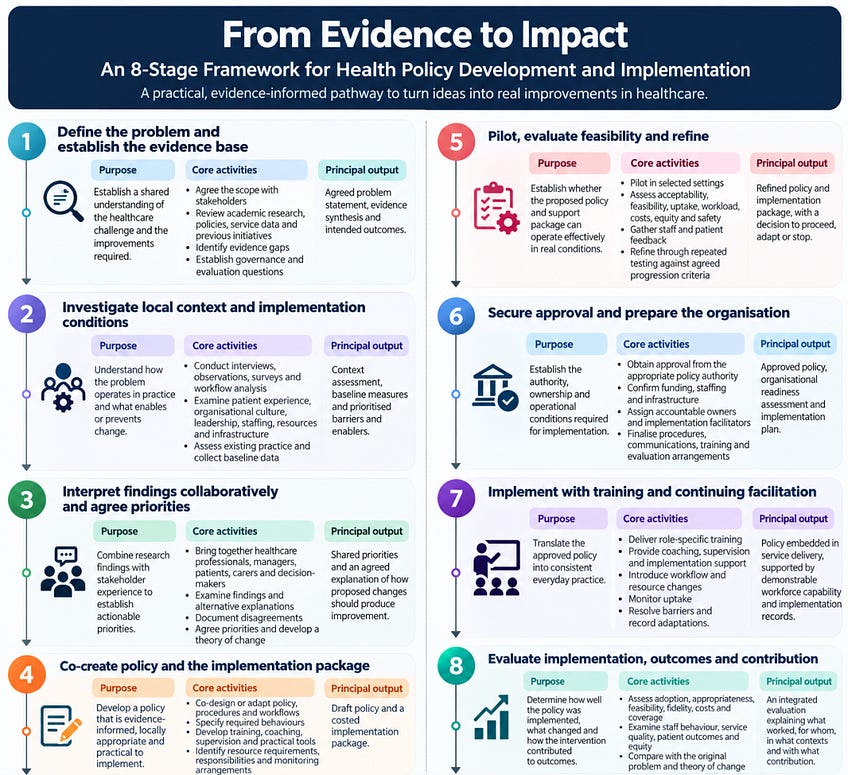
Introducing the Co-created Healthcare Policy and Practice Implementation Framework
Success at Ho Teaching Hospital raised an important question: how do we make this repeatable? My answer is a new framework, the Co-created Healthcare Policy and Practice Implementation Framework.
The framework is grounded in the established Knowledge-to-Action (KTA) approach developed by Graham et al. (2006), which connects knowledge creation with an iterative cycle of local adaptation, assessment of implementation barriers, tailored intervention delivery, evaluation and sustained knowledge use. Building on these principles, the framework incorporates explicit stages for stakeholder co-creation, policy development, workforce training and organisational facilitation, providing a structured approach to translating research into healthcare policy and practice (Graham et al., 2006; Field et al., 2014).
It moves through nine stages, from defining the problem to sustaining and extending what works:
What this means for healthcare leaders and practitioners
Start with people, not platforms. Before investing in new systems, find out why existing ones are not being used. The barriers are rarely technical.
Co-create, do not impose. Healthcare workers who help design training and policy are far more likely to adopt the change and sustain it.
Connect research, training and policy. Meaningful and sustainable change is achieved through interconnectivity. Each element strengthens the others; on their own, each falls short.
Plan for sustainment from day one. Embed responsibilities in routine budgets, induction, supervision and governance so that progress outlasts the project.
Work with me
If your organisation is investing in digital health but struggling to see adoption, I would like to hear from you. I work with hospitals, health ministries, training institutions and development partners across Africa to co-create capacity building programmes and digitalisation policies, and to apply the Co-created Healthcare Policy and Practice Implementation Framework in real settings. Let us build healthcare systems that are more connected, more efficient and better equipped to meet the needs of the people they serve.
About Digital Health Digest
Digital Health Digest features insights, ideas, and practical experiences from the people shaping digital health across Africa and beyond.
Are you working on a digital health initiative, policy, or innovation that deserves a wider audience? We welcome contributions from practitioners, researchers, policymakers, and innovators.
Interested in contributing? Follow Digital Health Digest on Substack and subscribe to our newsletter for more expert perspectives and developments in digital health.
Read the full story from Loughborough University: https://www.lboro.ac.uk/media-centre/press-releases/2026/october/loughborough-research-ghana-hospitals-improve-care/