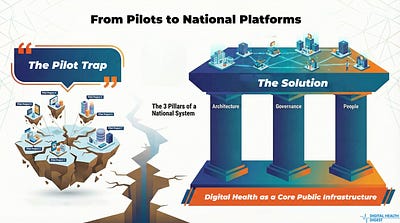
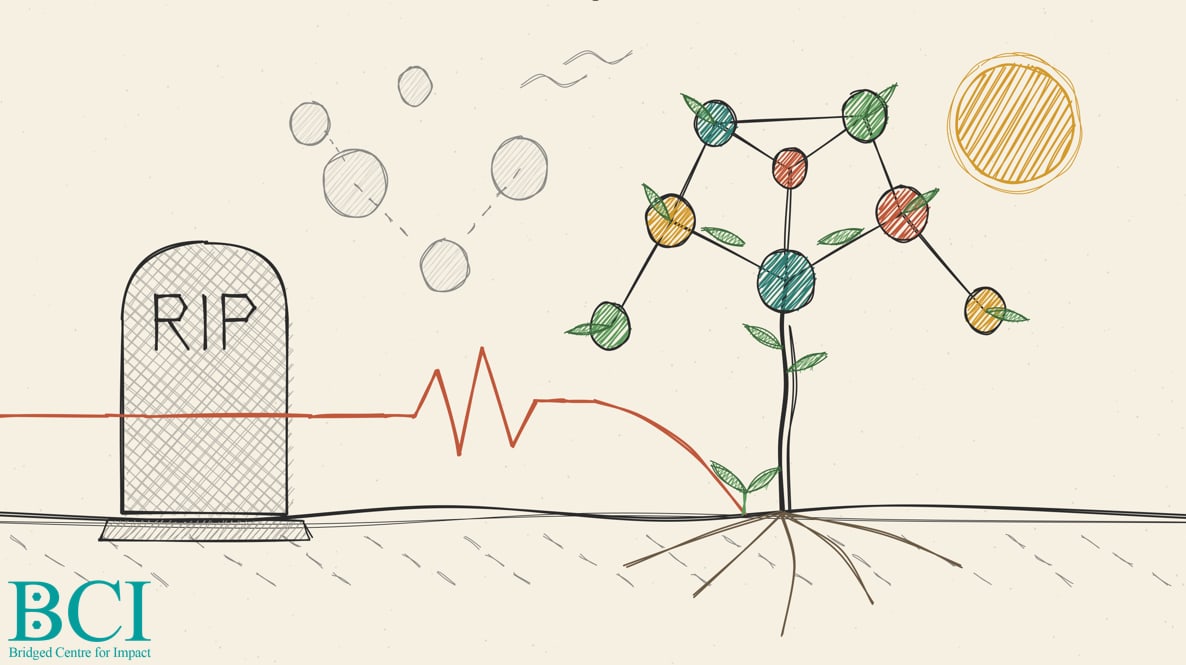
They were promising. They were well funded. They were celebrated at launch. And then, quietly, they died.
Dearly beloved, we are gathered here today to remember the digital health pilot.
You knew it. Perhaps you launched one. It arrived with a ribbon-cutting, a press release and a donor logo on the banner. It was going to transform care. Two years later, the laptops are in a cupboard, the login details are forgotten, and the only trace of it is a final report that says it ‘demonstrated strong potential for scale’.
Across Africa, digital innovations too often remain fragmented or confined to pilot projects, despite being technically feasible (Attom, 2026). In more than a decade of researching healthcare and leadership on this continent, I have attended many of these funerals. And I have noticed something about the death certificates. The technology is almost never the cause of death.
So in this issue, I want to do something a little different. I want to read the obituaries. Then I want to give you the survival guide.
A note before we begin: the four obituaries below are composites, built from patterns reported in the research evidence. They describe types of projects, not any specific initiative or organisation. Any resemblance to a project you once ran is, sadly, entirely likely.
The obituaries
1. The Pandemic Telemedicine Service
Born: 2020, in a crisis, to urgent necessity.
Lived: A brief, heroic life. When lockdowns closed the doors of clinics, it carried consultations to patients far from specialists.
Died: Quietly, when the emergency receded and everyone went back to how things were.
Cause of death: Never woven into everyday workflows. Some staff saw it as extra administrative burden, or a threat to the doctor–patient relationship, and nobody led them through the change (Kho, Gillespie and Martin-Khan, 2020).
Survived by: Its siblings in facilities where managers aligned the service with daily practice. They are still alive and well.
2. The Lonely Electronic Health Record
Born: To great fanfare, in one department of one hospital.
Lived: In isolation. An ‘island of information’, it held thousands of patient records and shared them with no one (Attom, 2026).
Died: Not dead exactly, but never fully alive. It still runs, while patients repeat their histories at every new door.
Cause of death: Nobody championed connectivity. Hospitals whose managers push for connections between departments have made real progress on interoperability; this one had no such champion (Ndlovu, Scott and Mars, 2021).
Survived by: A filing cabinet, which outlived it.
3. The Parallel Payment Platform
Born: With the dream of ending cash queues and manual billing.
Lived: Alongside cash, never instead of it. Staff did not trust it. Some patients could not use it.
Died: Of irrelevance, running as a parallel system with little operational impact.
Cause of death: Weak managerial capacity, which allowed it to generate trust concerns, staff resistance and exclusion rather than access (Attom, 2026).
Survived by: A famous cousin in Kenya. M-Pesa has helped reduce financial barriers for low-income patients there (Van Hove and Dubus, 2019), proof that the idea was never the problem.
4. The Brilliant but Unloved AI
Born: Very clever, to impressive parents in the technology sector.
Lived: On a dashboard nobody opened.
Died: Of loneliness. Frontline workers never trusted it, and patients never knew it existed.
Cause of death: Trust, or the lack of it, which shapes the whole process of change when AI enters healthcare (Steerling et al., 2023). No manager stepped up to champion it and win acceptance from the people expected to use it.
In lieu of flowers: The family asks that future AI projects budget for people, not just processors.
The coroner’s report
Read those four death certificates side by side and a pattern jumps out. Different technologies, different settings, the same underlying cause: a shortage of managerial capability.
That is the central argument of my Digital Managerial Capability Model. Digital technologies do not generate value on their own. Value emerges from the interaction between technology, the way organisations work, and the managers who connect the two. Where managerial capability is limited, digital initiatives are more likely to stay fragmented, underused or dependent on outside actors (Attom, 2026).
Two aggravating factors appear again and again in the evidence:
Self-taught managers. Many healthcare managers are learning digital tools on their own, through trial and error (Laakkonen et al., 2024). Courage is admirable; it is not a strategy.
The hierarchy cascade. Managers usually train and mentor junior staff on new systems. Where hierarchies are pronounced, as in many African health organisations, a gap at the top flows all the way to the frontline.
The verdict, then: these pilots did not die of natural causes. They died of neglect, and neglect is a management problem.
Six warning signs your project is on life support
Before you read on, check your own initiative. If you recognise more than two of these, it may be time to call for help.
Nobody can name, in one sentence, the manager accountable for it.
Success is reported as ‘number of sites installed’ rather than ‘number of staff and patients actually using it’.
Frontline staff were told about it rather than asked about it.
It does not share information with any other system your patients use.
Nobody has a plan for what happens when the external funding ends.
Nobody has asked which patients cannot use it.
Taking the vital signs
My model is built around four connections, which I like to think of as vital signs. Each one is a job that a manager must own. Use this chart at your next project review:
| Vital sign | Healthy | Critical |
|---|---|---|
| Adoption and governance | A named manager owns the project. Decisions are driven by service priorities. | Nobody can say who is in charge. The tool was chosen because it was offered. |
| Implementation and alignment | The tool fits how staff actually work. Frontline staff helped shape it. | Staff see it as extra work. Paper and digital run side by side indefinitely. |
| Feedback and adaptation | Usage is tracked. Staff and patients are heard, and things change as a result. | Success is measured by installation. Complaints go nowhere. |
| Sustainable impact | It is in the routine budget, job descriptions and induction. | Everything depends on one champion or one grant. |
If any vital sign reads ‘critical’, that is where to act first. And notice what is missing from the chart: there is no row for ‘the software’. The software is rarely what fails.
Write the obituary before the launch
Here is the slightly crazy idea at the heart of this newsletter. Before you launch your next digital health initiative, gather your team and write its obituary.
Project managers call this a premortem (Klein, 2007). Instead of asking ‘what could go wrong?’, which invites polite optimism, you imagine the project has already died, and ask ‘why did it die?’, which invites honesty. People who would never criticise a project in a planning meeting will happily explain its death.
It takes less than an hour. Here is how to run it:
Gather the people who will make or break the project: managers, frontline staff, IT, and if possible a patient or community representative.
Announce that it is two years from now and the project has failed completely.
Ask everyone to complete this sentence on their own: Here lies [project name]. It died because…
Read the obituaries aloud. Group the causes of death. Most will be about people, ownership, workflow, trust and funding, rather than technology.
For each major cause, agree one action and one named owner, today, while the patient is still alive.
I would be very surprised if the causes your team writes down do not map almost perfectly onto the four vital signs. That is the point. The deaths are predictable, which means they are preventable.
The survivors
Not every story ends at the graveside. Mobile payments have reduced financial barriers for low-income patients in Kenya. Telemedicine has lasted where managers aligned it with how staff actually work. Interoperability has improved in hospitals where managers champion connections between departments. Look closely at every survivor and you will find the same thing standing behind it: a capable manager who refused to let it die.
A word of honesty from the coroner
My model is a conceptual model, built from a critical synthesis of the evidence. It does not promise eternal life. Managerial capability is necessary but not sufficient: without consistent funding, supportive regulation and alignment with national health policy, even excellent managers can watch good projects fail. Evidence on the long-term, system-wide effect of digitally capable managers is still thin, and that is exactly why I want to test the model in real organisations.
But I am certain of this much. Africa does not need more pilots. It needs more survivors. And survivors are made by leaders.
Work with me
I am keen to connect with organisations across Africa that want to:
run a premortem or vital-signs review on a current or planned digital health initiative
develop managers with the capabilities to keep digital projects alive beyond the pilot stage
partner in research that tests and refines the Digital Managerial Capability Model in real settings
Get in touch: [email protected]
Read the full open-access article: https://doi.org/10.3389/fdgth.2026.1728920
References
Attom, A. (2026) ‘Health care management in Africa: a debate for future research and agenda’, Frontiers in Digital Health, 8, 1728920. doi: 10.3389/fdgth.2026.1728920.
Kho, J., Gillespie, N. and Martin-Khan, M. (2020) ‘A systematic scoping review of change management practices used for telemedicine service implementations’, BMC Health Services Research, 20(1), 815.
Klein, G. (2007) ‘Performing a project premortem’, Harvard Business Review, 85(9), pp. 18–19.
Laakkonen, N. et al. (2024) ‘Digital competence among healthcare leaders: a mixed-methods systematic review’, Journal of Nursing Management, 2024(1), 8435248.
Ndlovu, K., Scott, R. and Mars, M. (2021) ‘Interoperability opportunities and challenges in linking mHealth applications and eRecord systems: Botswana as an exemplar’, BMC Medical Informatics and Decision Making, 21(1), 246.
Steerling, E., Siira, E., Nilsen, P., Svedberg, P. and Nygren, J. (2023) ‘Implementing AI in healthcare—the relevance of trust: a scoping review’, Frontiers in Health Services, 3, 1211150.
Van Hove, L. and Dubus, A. (2019) ‘M-PESA and financial inclusion in Kenya: of paying comes saving?’, Sustainability, 11(3), 568.